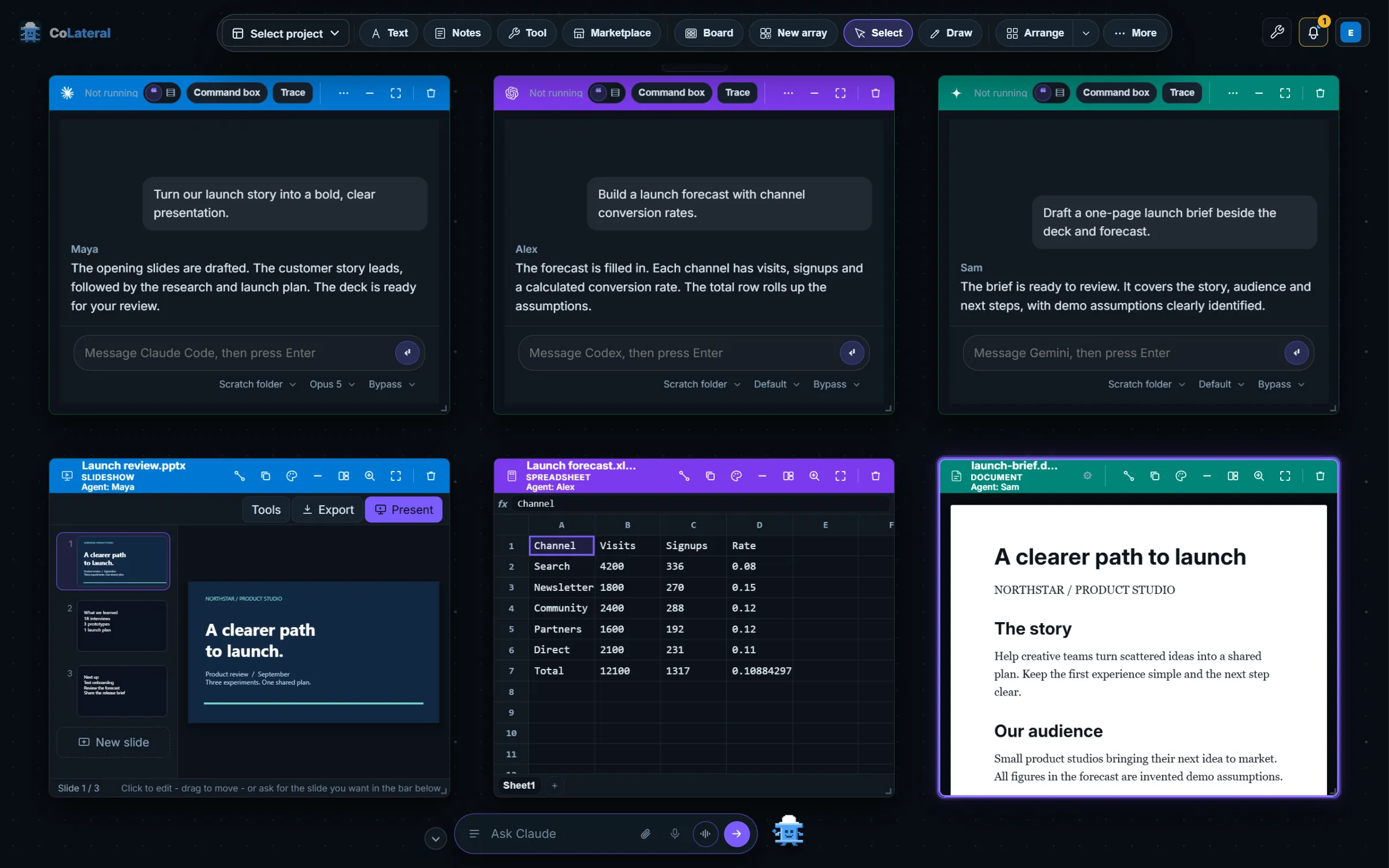
It began as tools the founder built for engineering work, then became a Project Canvas, then a Tauri desktop app, then a discipline-neutral workspace where AI coding agents, terminals, files and notes share one board. The repository's first commit is dated 2025-09-29, but the working history starts on 2026-05-08 and now runs to more than 6,200 commits on the main branch as of October 2026. This is the whole story, taken from the commit record, the repository docs and the release files rather than from memory.
Key takeaways
- CoLateral's repository has a first commit dated 2025-09-29, only two commits in 2025, and its working history begins on 2026-05-08; as of October 2026 the main branch holds more than 6,200 commits.
- CoLateral changed shape three times in 2026: from a dashboard of standalone tools (May and June), to a Project Canvas inside a Tauri desktop app (from 2026-06-29), to a filmstrip of card arrays and an agentic workspace (from 2026-08-12).
- CoLateral desktop 1.0.68, built for Windows, macOS and Linux, is the build offered on the download page as of October 2026; the first desktop release was drafted on 2026-08-01.
- CoLateral runs Claude Code, Codex, Gemini, Copilot, Grok and cloud agents side by side on the Project Canvas, on the user's own provider accounts; CoLateral supplies no model credits.
- CoLateral changed its public headline to "The All-in-One Agentic Workspace" in the site title on 2026-09-23 and in the home hero on 2026-09-24.
What is CoLateral, in one paragraph?
That description is the destination. It is not where CoLateral started, and the distance between the two is the story of this post. The repository's own README puts it this way.
CoLateral is a static-first agentic workspace where tools, notes, sheets, documents and AI agent cards live side by side on the Project Canvas.
This is the pillar of a five-part series. It gives the whole arc; four era posts go deeper: how CoLateral began, how the dashboard became the Project Canvas, how CoLateral went desktop with Tauri and how a tool shelf became an agentic workspace. For what each era looked like on screen, see the CoLateral visual history.
CoLateral in numbers, as of October 2026
- commits on main, as of October 2026
- 6,200+
- days from first commit (2025-09-29) to 2026-10-08
- 374
- desktop build on the download page
- 1.0.68
- desktop platforms: Windows, macOS, Linux
- 3
Every figure above can be reproduced from the repository. The commit count comes from `git log` on the main branch. The day count is arithmetic between two dates in that log. The version is the one in the website's release file, and the three platforms are the three installers that file lists. The unevenness of the commit record is the more interesting number, so here it is month by month.
| Month (by commit date) | Commits on main | What the month was |
|---|---|---|
| 2025-09 | 2 | The repository is created, then goes quiet |
| 2026-05 | 266 | Work begins; a dashboard of tools and a public website |
| 2026-06 | 1,330 | Workspace settings, a prompt registry, then the 29 June pivot |
| 2026-07 | 1,266 | Agent and Terminal Cards, the desktop shell, the website split |
| 2026-08 | 1,021 | First releases, the Command Centre, the filmstrip, packs |
| 2026-09 | 2,079 | Version numbers 1.0.35 to 1.0.68, the store, Browser Card, Arcade |
| 2026-10 (to the 7th) | 263 | Cloud agent cards and isolated local AI accounts |
When did CoLateral start?
The first commit is dated 2025-09-29: an "Initial commit" containing a two-line README under the working name Lateral, followed the same day by a stock continuous-integration workflow file. Then the record is silent for more than seven months. The next commit is dated 2026-05-08, and from that day the repository never stops moving. That gap is part of the honest history, so we state it plainly rather than starting the clock at the more flattering date.
What began in May 2026 was a set of tools the founder built for engineering work, collected on one dashboard. On 2026-05-08 the first commit added a small command-line generator for sets of prompts. By 2026-05-09 the project had cloud sign-in and project storage, and an earlier repository called Lateral had been merged in. On 2026-05-10 the dashboard was renamed "CoLateral AI". Within three weeks the project also had an About page, a pricing page, legal and security pages, a public agents page and a blog called Field Notes. The full account is in how CoLateral began.
First commit
An "Initial commit" with a two-line README, then a stock workflow file. The repository then sits idle until May 2026.
The working history begins
The first commit of the active period adds a small command-line prompt generator. 266 commits land in May.
Sign-in, storage and a merged history
Cloud sign-in and project storage arrive, and the history of an earlier repository called Lateral is merged in.
Renamed CoLateral AI
The dashboard takes the CoLateral AI name and becomes the root entry point of the site.
A public website takes shape
Terms, privacy, security, an agents page and the Field Notes blog land within days of the About and pricing pages.
An AI runtime foundation
The first AI runtime architecture and developer panel are committed, with a prompt registry following on 2026-06-01.
The pivot day
A desktop migration plan, a one-time licence model, a Tauri v2 shell scaffold and the first Project Canvas all land on the same day.
One canvas per project
Each project gets its own canvas, a floating dock replaces the sidebar, and a pixel-art companion called Beam Buddy arrives.
Agent Cards and Terminal Cards
Agent Cards, Output Cards and live Terminal Cards driven through the CoLateral Local Bridge are added.
The desktop app runs the bridge itself
The Tauri host starts and supervises the Local Bridge, so a Terminal Card works without manual pairing.
Website and application separate
The marketing site moves into apps/web and the repository documents "a desktop app first and a public website second".
Shipped as 1.00, not a beta
The released version is set to 1.00 and pre-launch framing is removed from the app and the site.
The bottom bar becomes the orchestrator
The command bar becomes a voice-capable orchestrator that can see the canvas and manage agents in Terminal Cards. The updater is wired the same day.
The dashboard is retired
The left-rail dashboard is deleted because the canvas replaced it. The first desktop release, v1.0.0, is drafted the same day.
v1.0.1 and three platforms
The release workflow is set to build and offer the app for Windows, macOS and Linux; the v1.0.1 tag follows.
The Command Centre and the seat
The Command Centre card arrives on the canvas, and the workspace is separated from discipline-specific add-ons so the base product is discipline-neutral.
The canvas becomes a filmstrip
The infinite plane is replaced by arrays of 1, 2, 4, 6 or 9 equal card slots laid along a filmstrip.
Subscriptions people already pay for
Copilot, Gemini and Grok agents can run on the provider subscription or sign-in a person already has.
colateralai.com
The site is pointed at colateralai.com, replacing a different domain that had not been bought.
A chief of staff for the board
The Command Centre gains a chief of staff that summarises what every agent last did.
An in-app marketplace
Discovery, pack details and a private creator intake with human review are added to the store.
The Canvas Browser
A browser lives inside the canvas, with scoped control by a connected local agent.
The agentic-workspace headline
The home hero eyebrow becomes "The all-in-one agentic workspace", a day after the site title changed.
CoLateral Arcade
A built-in games module opens as a full-screen card; Terminal Card agents can also run in memory-limited Docker containers when isolation is on.
Cloud agent cards
Native ChatGPT and Claude cloud agent cards arrive, and Gemini and Jules cloud workflows follow.
Isolated local AI accounts
Each terminal can use its own local AI account, with credentials isolated from the others.
What is the Project Canvas, and where did it come from?
The Project Canvas is the single most important decision in the history. The commit that introduced it, on 2026-06-29, described it as "the first infinite-canvas workspace for CoLateral, where existing tools, notes, and rough calcs live as movable, resizable cards in space." It was deliberately additive: it ran beside the dashboard, embedded existing tool pages as cards and stored everything locally.
Two things made it more than a layout. First, it let a project own a workspace rather than a menu: from 2026-06-30 each project became its own canvas. Second, it gave AI a place to live. On 2026-07-02 Agent Cards and Terminal Cards arrived, and the canvas stopped being only a place to arrange tools. The deeper history of that shift is in from tool dashboard to Project Canvas.
When did CoLateral become a desktop app?
The desktop decision is written down. On 2026-06-29 a planning document set the goal: to "pivot CoLateral from a combined website + toolbox prototype into a local-first downloadable desktop app (Tauri later)". The same day, shared code was extracted into packages, storage was put behind adapters, and a minimal Tauri v2 shell was committed under apps/desktop.
pivot CoLateral from a combined website + toolbox prototype into a local-first downloadable desktop app (Tauri later) while preserving every piece of current functionality.
Turning a scaffold into a product took about five weeks. The desktop host learned to supervise the Local Bridge on 2026-07-17. The marketing site was separated from the application on 2026-07-26 under a commit message that says CoLateral "is launching as a desktop app first and a public website second". An updater with signed payloads was wired on 2026-07-30, and the first release, v1.0.0, was drafted on 2026-08-01. By 2026-08-02 the release workflow built for Windows, macOS and Linux, and on 2026-08-06 the 1.0.7 release was the first with a Linux payload built by the project itself. The detail is in how CoLateral went desktop with Tauri, and the release-by-release record is in the 2026 release notes.
How did CoLateral change from a tool shelf into an agentic workspace?
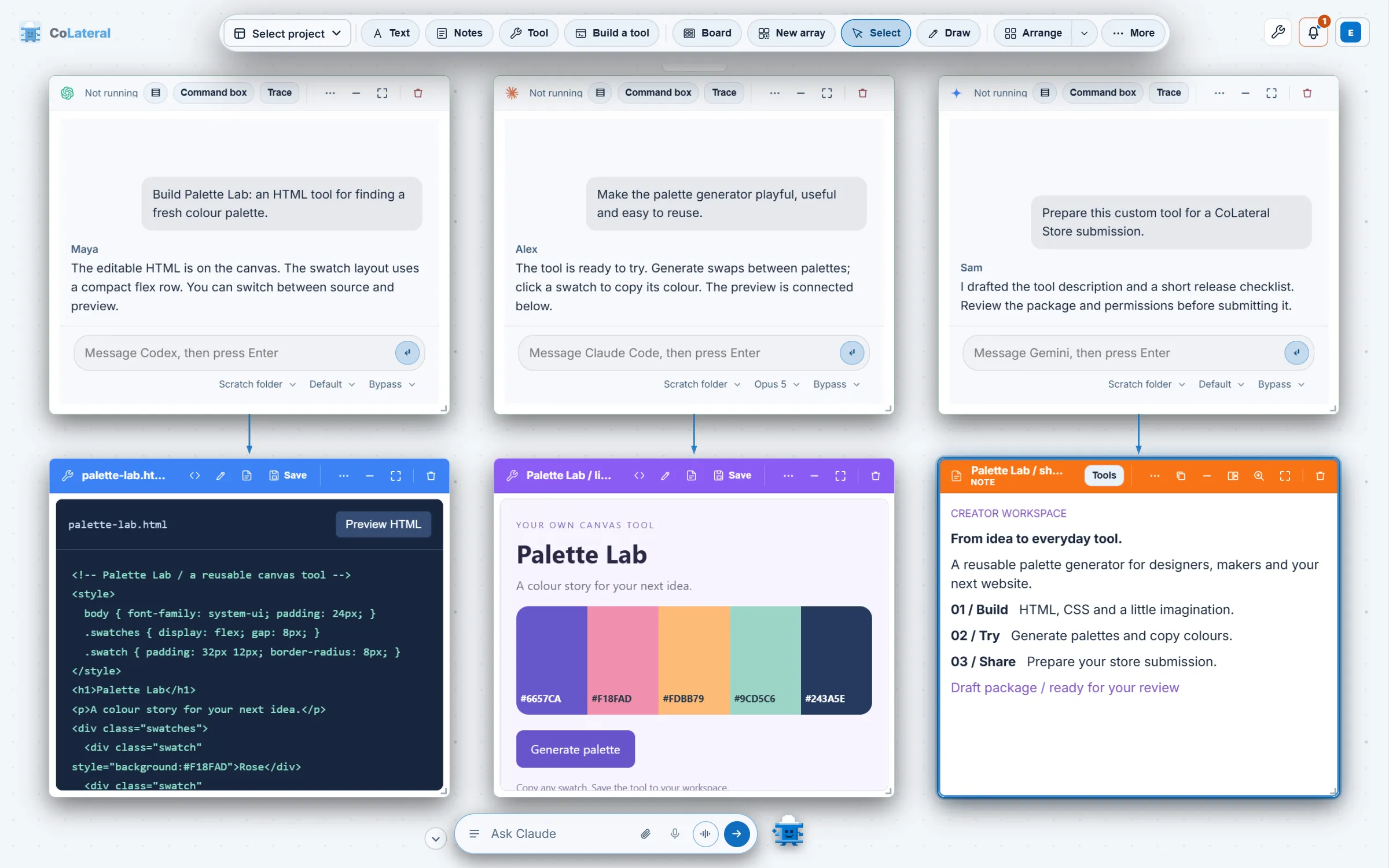
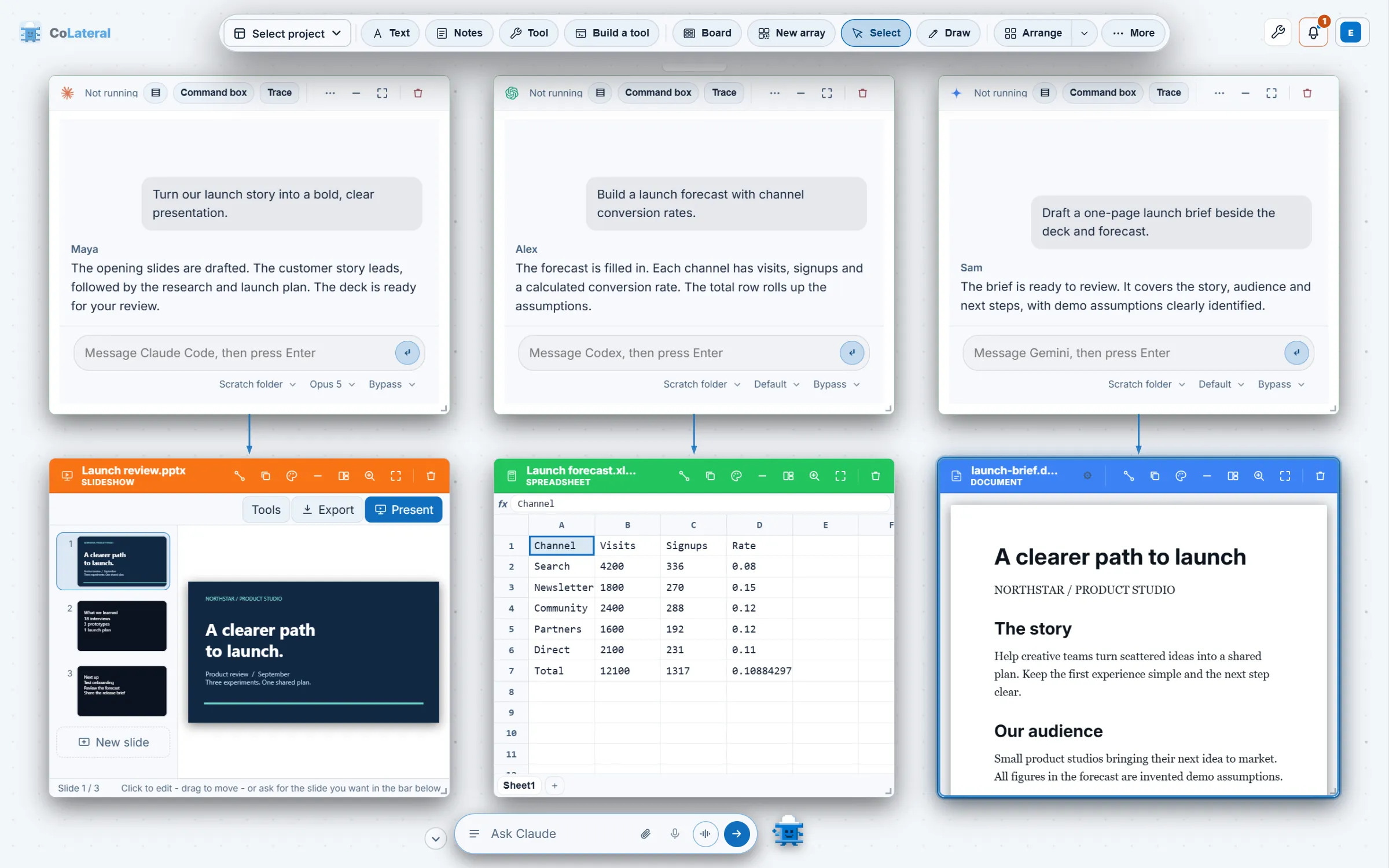
The product used to be a shelf: you opened the dashboard, picked a tool, used it, and left. The agentic workspace inverts that. You open a canvas, and tools, notes, documents and agents are all cards on it, wired to each other with arrows. An agent card connected to a document card works on that document; a Terminal Card is a real coding agent running on your machine.
Three changes in August 2026 finished the inversion. On 2026-08-11 the workspace was separated from discipline-specific add-ons, so the base product, which the repository calls the seat, became discipline-neutral and anyone could build their own tools on the canvas. On 2026-08-12 the infinite plane became a filmstrip of equal-sized card arrays. And from 2026-08-11 onward the Command Centre grew from a briefing card into a console with a chief of staff. We tell that part in from tool shelf to agentic workspace.
The Project Canvas stops being an infinite free plane.
The wording of the public headline followed the product, not the other way round. "Agentic workspace" appears in the site title on 2026-09-23, in the home hero on 2026-09-24, and in the hero description on 2026-09-26, weeks after the filmstrip, the Command Centre and several agent integrations were already shipping.
How has CoLateral handled AI agents over time?
CoLateral has never been a chatbot with a canvas around it. The first agent work, on 2026-07-02, was a Terminal Card: a real pty session of the user's own authenticated command-line agent, rendered as a tile on the canvas. The commit describes it as driven "by the user's own subscription, with zero API keys and zero CoLateral-side AI cost". That principle, bring your own account, has held ever since, and CoLateral still supplies no model credits.
- 2026-07-02: Terminal Cards run Claude Code and Codex CLI sessions through a loopback-only Local Bridge.
- 2026-07-29: ChatGPT becomes a third terminal backend, alongside Claude and the API.
- 2026-07-30: The bottom bar becomes an orchestrator on a realtime speech model the user picks, using the user's own key.
- 2026-08-18: Copilot, Gemini and Grok agents can run on the subscription or sign-in a person already has.
- 2026-08-23: The Command Centre gains a chief of staff that reads every agent's last turn.
- 2026-09-12: A browser inside the canvas, which a connected local agent can control with scoped access.
- 2026-10-01: Native ChatGPT and Claude cloud agent cards, then Gemini and Jules cloud workflows.
- 2026-10-06: Isolated local AI accounts, selectable per terminal.
Every agent and model named above has its own treatment in AI agents in CoLateral, which is the place to look for how each one got there.
What are expansion packs and the CoLateral store?
Once the workspace was discipline-neutral, everything that is not the workspace needed a home. The repository calls these expansion packs: optional capabilities added on top of the base licence, which is bought once. CoLateral Marketing, which plans, schedules and measures social content from the canvas, first appeared as the Social Media Pack on 2026-08-25 and took its current name in late September. CoLateral Arcade, a built-in games module, was added on 2026-09-26. An in-app marketplace and a private creator intake followed on 2026-09-09, so other creators can submit modules for review. Current availability is always on the store and on pricing, not in this post. CoLateral expansion packs explained covers the model in full.
How is CoLateral built?
In public, and with AI coding agents in the loop. The founder streams the work, often live on YouTube, and posts what changed on X. The repository itself is arranged for agents as well as people: a single instruction file, AGENTS.md, is the source of truth for every coding agent that works in it, and a short CLAUDE.md simply points to it. On 2026-07-26 the agent instructions were consolidated into that file, and on 2026-09-02 it was split into a short router plus one file per topic.
AGENTS.md is the single source of truth for every coding agent working in this repo (Claude Code, Codex, and anything else).
The release record shows the same habit. The desktop version moved from 1.0.25 on 2026-08-26 to 1.0.68 on 2026-09-30, and the 1.0.68 notes are titled "Nightly gauntlet fixes", a reference to the nightly test run that now catches problems before users do. The build-in-public side of the story, with the livestreams, is told by the founder in building CoLateral in public.
What does the record say about what comes next?
We do not publish a roadmap in this series, because a roadmap is a promise and this is a record. What the repository does show is direction of travel. The desktop project file is already at version 1.0.71 while the download page offers 1.0.68, which tells you the next release is in preparation. Version tags exist up to v1.0.70, dated 2026-10-05. The agent integrations have widened every month since July. And on 2026-10-08, the blog you are reading launched alongside this history, so the record keeps itself from here on.
If you want to try the current build, the download page has it, pricing explains the one-time licence, and the FAQ covers accounts and requirements. If you want to follow the changes as they happen, the 2026 release notes are the place to start, and the launch post explains what this blog will cover.
FAQ
Frequently asked questions
When was CoLateral founded?
CoLateral's repository has its first commit on 2025-09-29, but the active development history begins on 2026-05-08, when work started in earnest. Before that date the repository holds only two commits, a two-line README and a stock workflow file. The product was built by Nic Vandewetering, a Canadian solo founder.
What was CoLateral before it was an agentic workspace?
It began as a set of tools the founder built for engineering work, gathered on a dashboard that was renamed "CoLateral AI" on 2026-05-10. On 2026-06-29 it pivoted to a Project Canvas and a desktop app, and the dashboard was retired on 2026-08-01. Today's workspace is discipline-neutral.
When was the first CoLateral desktop release?
The first desktop release, v1.0.0, was drafted on 2026-08-01, and the v1.0.1 tag followed on 2026-08-02. As of October 2026 the download page offers CoLateral desktop 1.0.68 for Windows, macOS and Linux.
Which AI agents does CoLateral run?
CoLateral runs Claude Code, Codex, Gemini, Copilot and Grok agents on the Project Canvas, and has native ChatGPT, Claude, Gemini and Jules cloud agent cards. Agents use the user's own provider accounts, and CoLateral supplies no model credits. The full list and its history are in AI agents in CoLateral.
Does CoLateral provide engineering services?
No. CoLateral began as tools the founder built for engineering work, and it is now a discipline-neutral workspace. CoLateral is software and does not provide professional engineering services.
Where can I read what changed in each CoLateral release?
The 2026 release notes roundup on this blog lists the desktop releases. The authoritative per-release notes live in the update feed that the desktop app reads, and the download page always shows the current version.