It was built with Tauri, released first to a closed beta, and it broke in instructive ways on the way. This is part 3 of the history of CoLateral: the fortnight in which a canvas in a browser became software you install.
Key takeaways
- CoLateral separated its public website from the desktop application on 2026-07-26, with the commit stating that CoLateral "is launching as a desktop app first and a public website second".
- CoLateral set its released version to 1.00 on 2026-07-29, wired a signed updater on 2026-07-30, and drafted its first desktop release, v1.0.0, on 2026-08-01.
- CoLateral's release workflow was set to build for Windows, macOS and Linux on 2026-08-02, and release 1.0.7 on 2026-08-06 was the first with a Linux payload built by the project itself.
- CoLateral retired its left-rail dashboard on 2026-08-01 because the Project Canvas had replaced it, leaving the canvas as the single place to work.
Why did CoLateral launch as a desktop app first?
Because the product needed to run agents on your machine, and a website cannot do that. By mid-July the canvas could host live Claude Code and Codex sessions through a local bridge, as described in the previous post, and the Tauri host had learned to start that bridge itself on 2026-07-17. What remained was to stop treating the marketing site and the application as one thing. On 2026-07-26 the repository was split into two products out of one tree.
CoLateral is launching as a desktop app first and a public website second.
The website moved into apps/web with its own build, which assembles a distributable site from page sources and a short list of shared brand assets. A new download page became the primary call to action, driven by a single release record so that it said "Coming soon" until installers were really published. The application kept its entrance page and learned the website's address from one configuration file instead of hard-coded links. The two have stayed separate since, and the blog you are reading is built by that same website build.
How did CoLateral add licensing, payments and updates?
In the last week of July. Payments came first: on 2026-07-27 every paid plan was mapped to a Stripe Payment Link, with a welcome page for Stripe to return to, and a pricing tier with no link yet falls back to a request-access form rather than showing a dead buy button. The purchase webhook was signed the same day. On 2026-07-30 a release path for Windows and macOS installers was added, deliberately left switched off until it could be signed, and the licence verifier was matched to what the issuer actually emits. Prices have changed since and live on pricing, not here.
The updater was wired before any release, deliberately. The commit explains why in a sentence worth keeping.
Doing this after the first release is too late: a copy installed without an updater can never be told where to look.
Update control stays in Rust beside the licence gate, so the web page decides how to ask for an update but never whether a payload is trustworthy: the plugin verifies a signature against a compiled-in key before anything reaches the interface. A licence activated with a signed key, and an updater that can fix a shipped bug are the two things that turn a repository into a product.
What did the app gain just before 1.00?
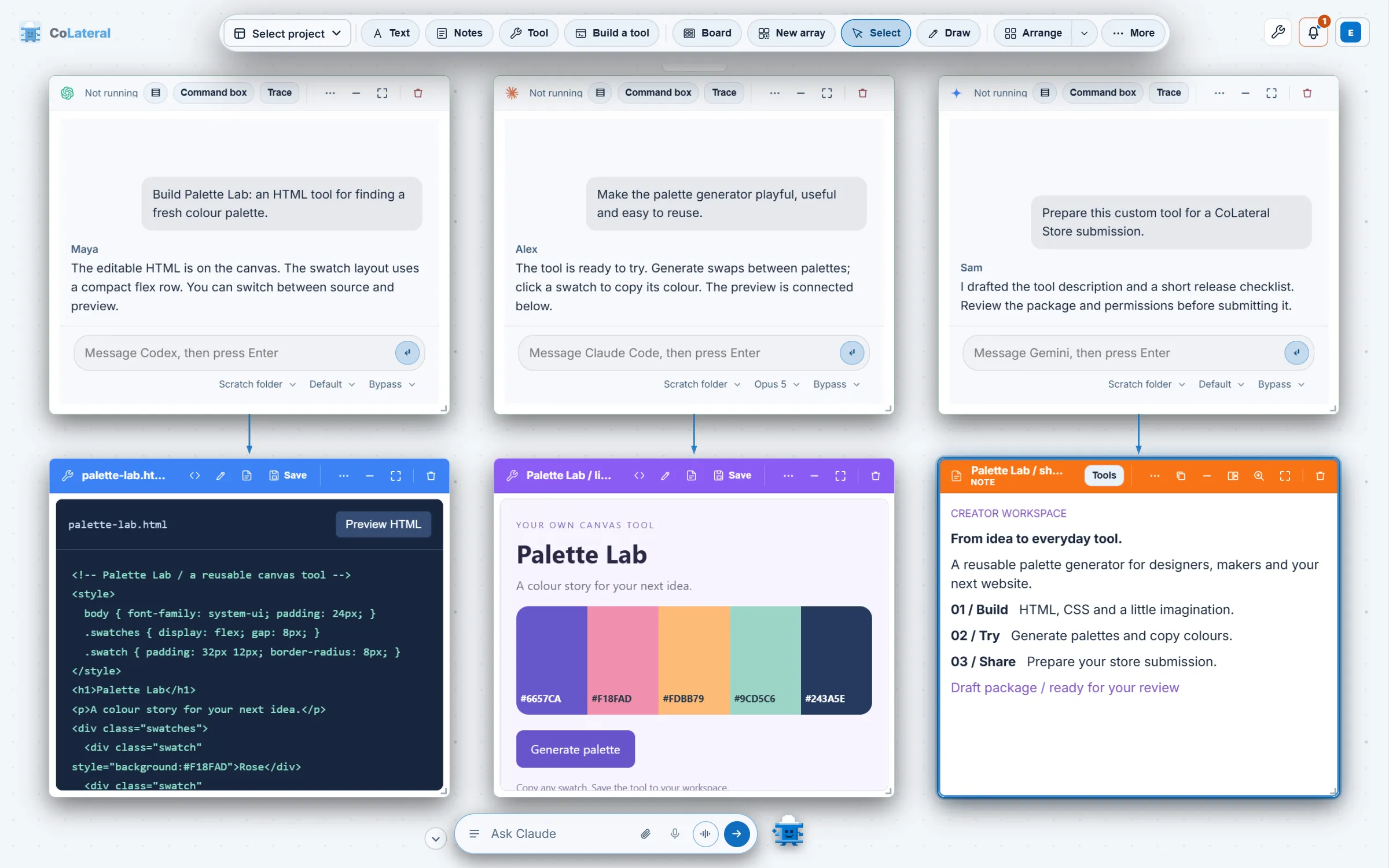
Three features landed in the last days of July, and each is still central. On 2026-07-28 Terminal Cards became first-class, with a dock button and a real Windows terminal, and an agent could answer using the user's Claude Code sign-in with no API key. On 2026-07-29 ChatGPT became a third terminal backend beside Claude and the API, and agents were allowed to act on the canvas instead of describing what they would do.
On 2026-07-30 the bottom bar became an orchestrator. It runs on a realtime speech-to-speech model the person picks, on their own API key, and can see the whole canvas, drive canvas actions and manage the coding agents in Terminal Cards. Three models shipped at first: GPT Realtime 2.1, GPT Realtime 2.1 Mini and Grok Realtime Voice. Typing still hits a local parser first, so "drop a note" costs nothing and waits for nothing. That bar is the ancestor of the chief of staff covered in the next post.
Between those, on 2026-07-29, the released version was set to 1.00, and pre-launch framing was removed from the settings, the tool manifest and the public site. A launch-readiness test fails if a beta label ever returns.
How did the CoLateral closed beta work?
Carefully and by hand. On 2026-07-31 a way to issue closed-beta licence seats without going through Stripe was added, so testers received ordinary licences rather than a parallel kind. On 2026-08-01 the beta application form opened, and a seat was capped at two weeks. By 2026-08-05 seats could be handed out from Discord without an operator. The repository's own archived roadmap now records the outcome: CoLateral has launched publicly and is on sale, and the closed beta is over.
The beta is why this era is full of small, specific releases. Testers installed real builds on real machines, and the project shipped a fix for each thing they hit.
What happened in CoLateral releases 1.0.0 to 1.0.9?
The first desktop release, v1.0.0, was drafted on 2026-08-01 with a Windows installer. The table below records what each early version was for, taken from its own commit message. It is an honest list: several of these versions exist because the previous one had a problem.
| Version | Date | Why it shipped |
|---|---|---|
| 1.0.1 | 2026-08-02 | A build that could actually activate a licence, without waiting on a DNS change |
| 1.0.2 | 2026-08-03 | Fixes for a crash loop that exited without writing down why |
| 1.0.3 | 2026-08-03 | Licence recovery fixes, so a tester's key rotation could not strand them |
| 1.0.4 | 2026-08-03 | A beta tester's fixes, including finding Node when the app could not see it on PATH |
| 1.0.5 | 2026-08-03 | An update that finishes by itself on a Mac, by relaunching after install |
| 1.0.7 | 2026-08-06 | The first release with a Linux payload built by the project itself |
| 1.0.8 | 2026-08-11 | Carried the new Command Centre card to the desktop, for Windows only |
| 1.0.9 | 2026-08-12 | Restored an update path for macOS and Linux after the Windows-only 1.0.8 |
Three platforms did not happen by accident. On 2026-08-02 the macOS job was switched on by default, a Linux job was added to produce an AppImage and a .deb package on an older runner so the binary runs on more systems, and the version check moved to a preflight so a mismatch costs seconds rather than three parallel builds. The full per-release record, with notes written for users, is in the 2026 release notes.
Why did CoLateral retire the dashboard?
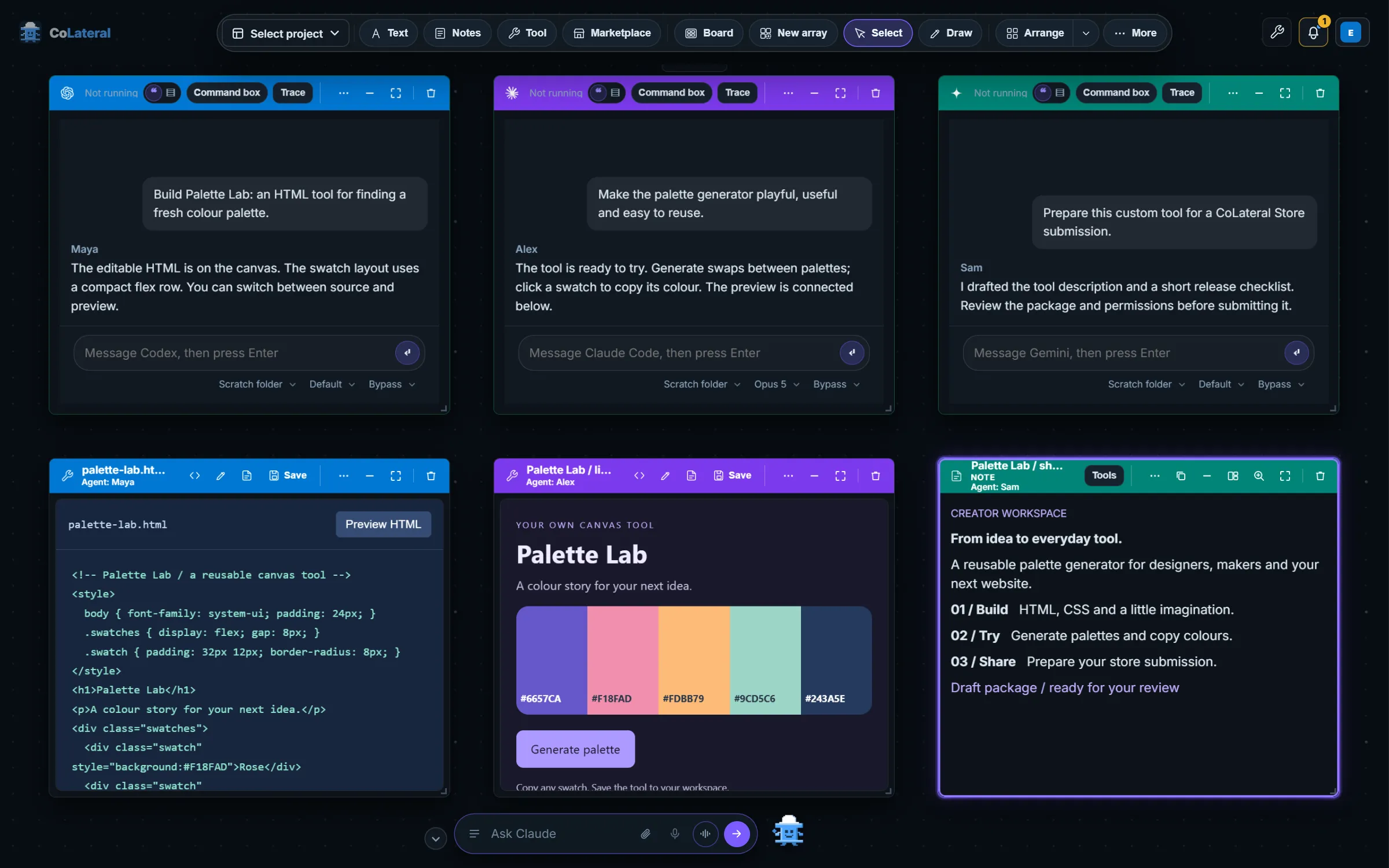
Because it had two homes and only one could win. On 2026-08-01 the left-rail dashboard and its Tool Library page were deleted, and every link that pointed to them was repointed to the canvas.
The dashboard view (a left nav rail plus a Tool Library page) and the canvas were two answers to the same question, and the canvas won.
On 2026-08-06 Account & Settings became the one settings surface. From then on the app had two entry points rather than a maze: an entrance page and the canvas.
What did this era mean for people using CoLateral?
- CoLateral became something you download and install, for Windows, macOS or Linux, from the download page.
- It receives signed update payloads, so a bad release can be followed by a fix.
- It runs agents on your own accounts, with a bar that can orchestrate them by text or voice.
- It has one place to work, the canvas, rather than a dashboard plus a canvas.
It also meant a new discipline for the project. A shipped app has to be honest about what is in it, and the commit record from this fortnight shows a project learning to say so, with releases named for what they fixed and a release process that refuses a build whose installers disagree with the tag. The next chapter is the biggest redesign yet: a Command Centre, a filmstrip and the shift to an agentic workspace. The whole span is in the pillar history.
FAQ
Frequently asked questions
When was the first CoLateral desktop release?
The first desktop release, v1.0.0, was drafted on 2026-08-01, and the v1.0.1 tag followed on 2026-08-02. The released version had been set to 1.00 on 2026-07-29, and the app has been updated through signed payloads since.
What is CoLateral built with?
CoLateral's desktop app is built with Tauri, which wraps the web-based workspace in a native window and provides the licence gate and updater in Rust. A first Tauri v2 shell was committed on 2026-06-29.
Does CoLateral run on Windows, macOS and Linux?
Yes. The release workflow builds for all three, and the download page offers a Windows installer, a macOS universal disk image and a Linux AppImage and deb package. Linux builds first appeared with release 1.0.7 on 2026-08-06.
Was there a CoLateral beta?
Yes, a closed beta ran from late July into August 2026, with seats issued by application and capped at two weeks each. The repository now records that CoLateral has launched publicly and that the closed beta program is over.
How does the CoLateral desktop app receive updates?
The app checks a signed update feed, and its Rust code verifies each payload against a key compiled into the app before anything is installed. The updater was wired on 2026-07-30, before the first release, so that a shipped bug could be fixed.