The Project Canvas turned from an infinite plane into a filmstrip of card arrays on 2026-08-12, a Command Centre with a chief of staff began running the board, more AI agents were added on the accounts people already pay for, and the public headline became "The All-in-One Agentic Workspace" on 2026-09-23. This is part 4 of the history of CoLateral, and it covers the stretch that made the product what it is today.
Key takeaways
- CoLateral replaced its infinite canvas with a filmstrip of card arrays on 2026-08-12, where each array is a fixed page of 1, 2, 4, 6 or 9 equal card slots, and removed the minimap, zoom and folders over the following day.
- CoLateral added the Command Centre card on 2026-08-11 and a chief of staff on 2026-08-23, and by 2026-08-26 the chief of staff and the bottom-bar orchestrator were one agent with one transcript.
- CoLateral added Copilot, Gemini and Grok agents on 2026-08-18, each running on a subscription or sign-in the person already has, starting with Copilot for people whose employer approves only that tool.
- CoLateral introduced the "agentic workspace" headline in its site title on 2026-09-23 and in the home hero on 2026-09-24, weeks after the underlying product had shipped.
What changed in CoLateral between August and October 2026?
More than in any earlier era, and it is easiest to see as five threads that ran at once. The canvas was rebuilt around arrays. A console called the Command Centre became the board's home. The set of agents widened from two to many. The base product was separated from optional add-ons so it could be discipline-neutral. And a store opened for those add-ons. The desktop releases carried all of it: the version number moved from 1.0.25 on 2026-08-26 to 1.0.68 on 2026-09-30. The first releases are in part 3, and the later notes are collected in the 2026 release notes.
How did the Project Canvas become a filmstrip?
On 2026-08-12 the canvas stopped being an infinite plane. The commit that did it said so in its first sentence.
The Project Canvas stops being an infinite free plane.
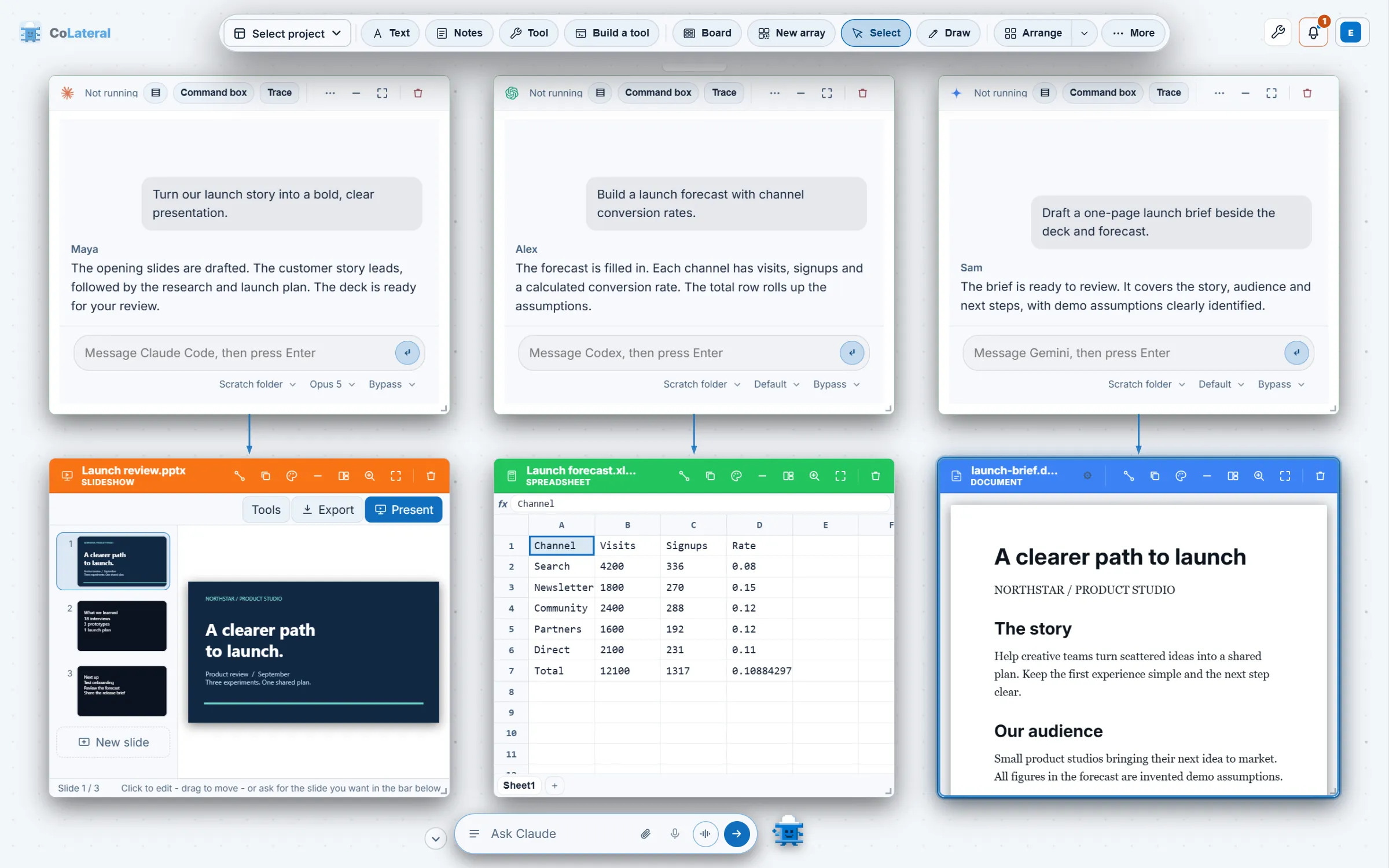
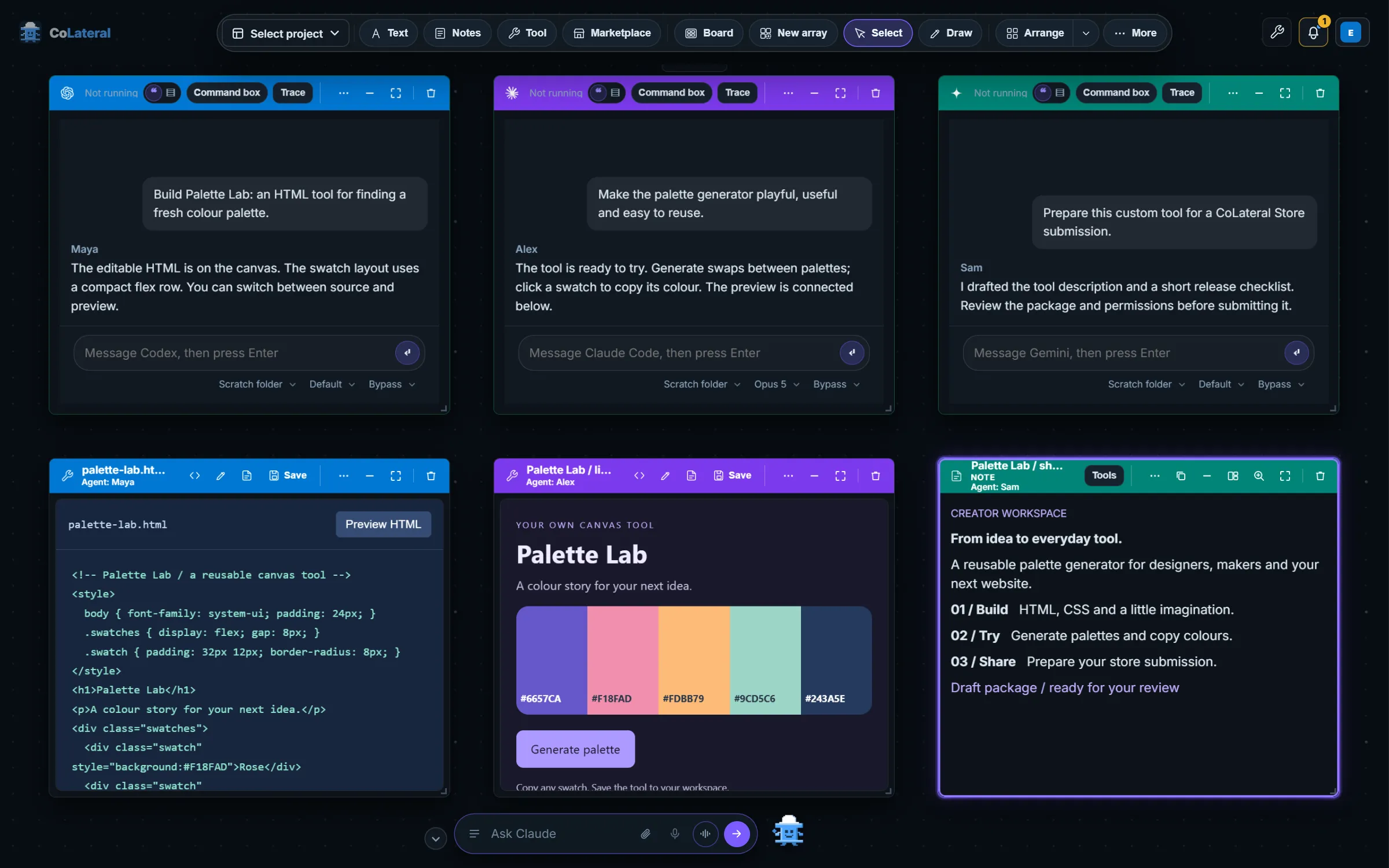
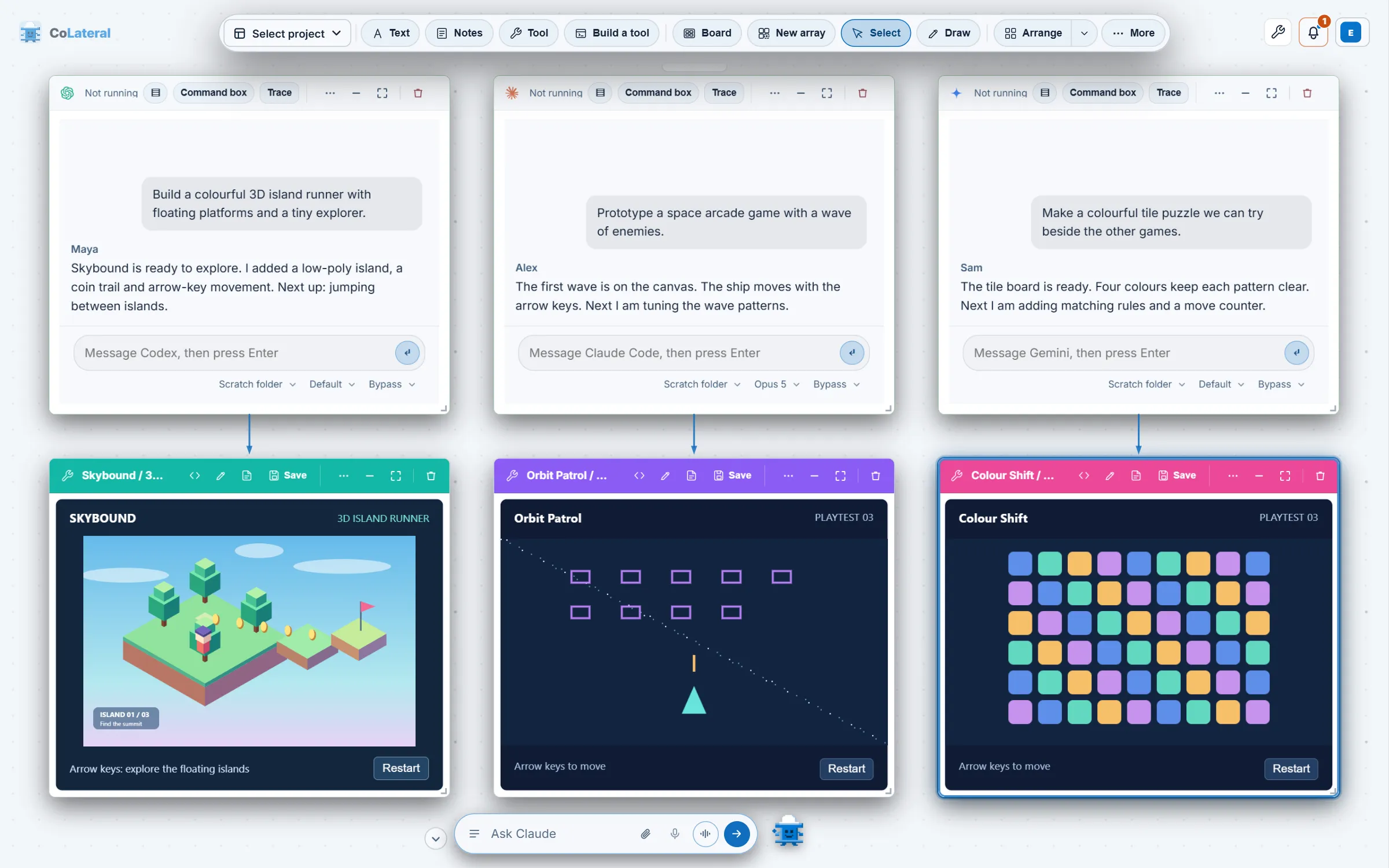
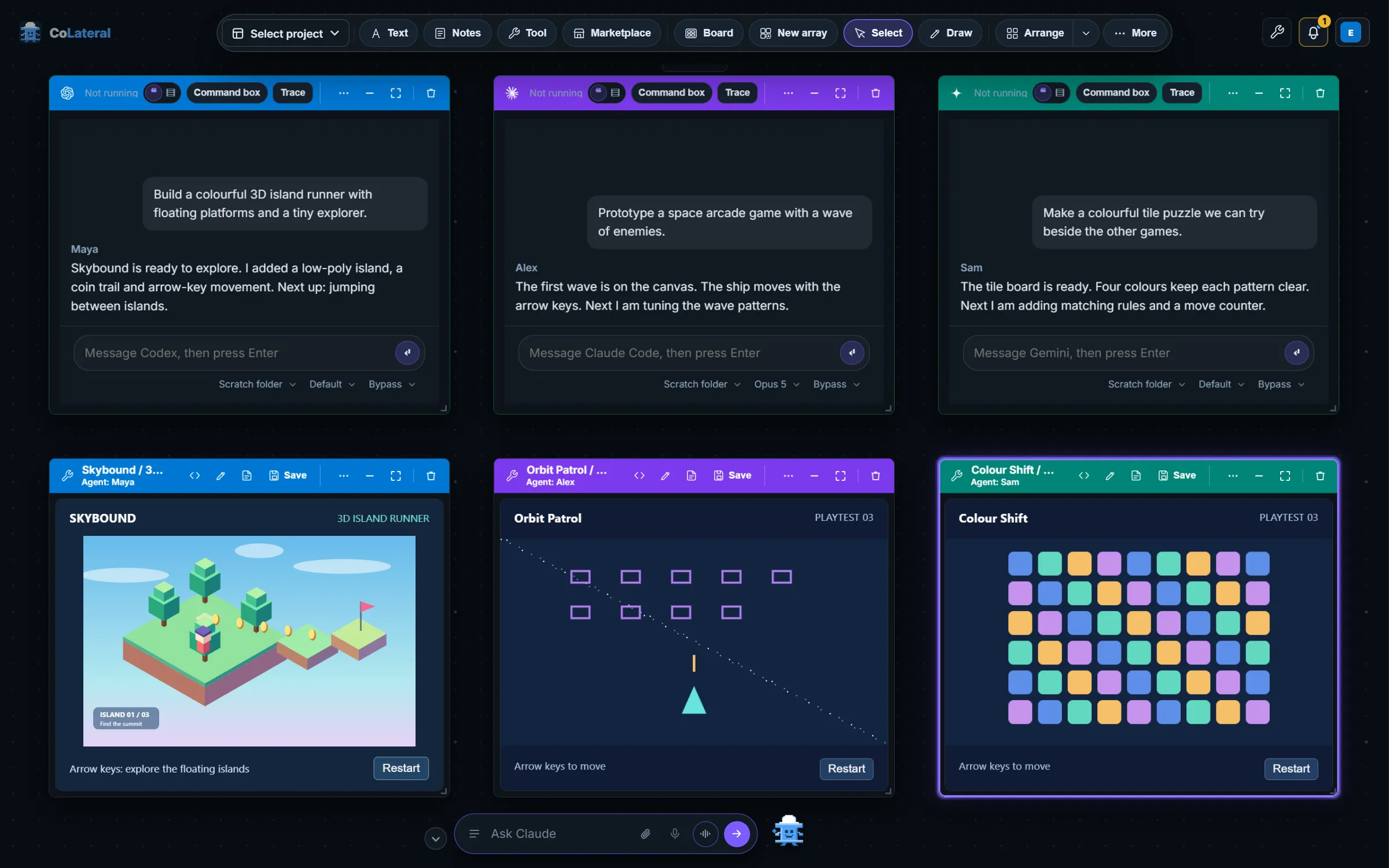
Cards became the same size, snapped into arrays, one array per fixed page of a one-dimensional strip. A page is 2560 by 1600 world units, a 16:10 shape that lines up exactly with the grid the canvas already drew. A card can span several slots, and a card kind can declare a minimum size, so a terminal or a slideshow is never crammed into a ninth of a page. The migration of existing boards was written as a pure function with its own tests, because a bad migration would silently rearrange a real project.
Much was removed. Zoom stopped being a user feature on the same day, because the canvas now travels between arrays. The minimap went because, as the commit explained, a minimap answers where your viewport is inside a large plane, and this was no longer a plane. Its replacement keeps working at scale.
The filmstrip answers the same question and keeps answering it at fifty arrays, because it scrolls instead of scaling.
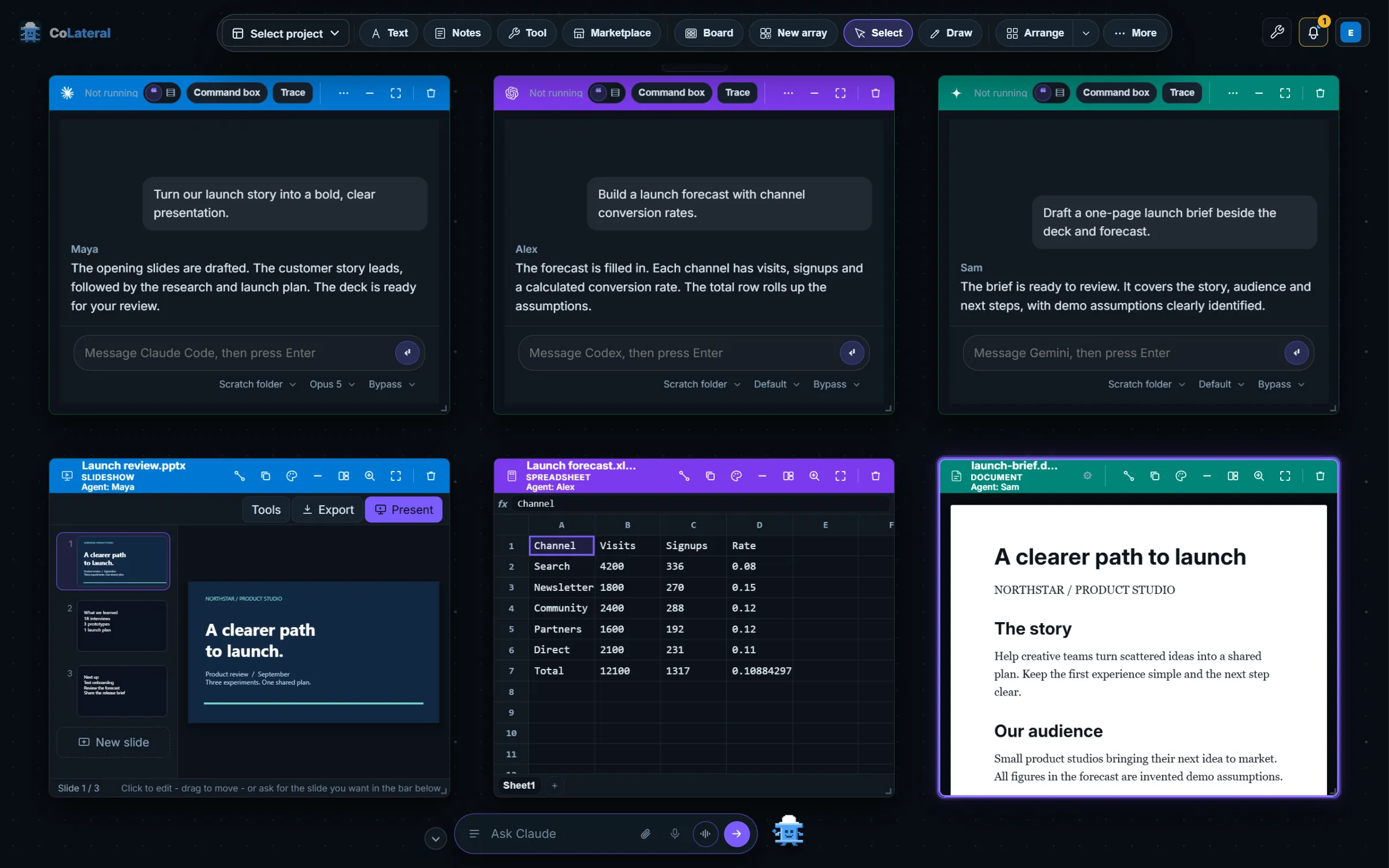
The Tidy button became Arrange, which sorts cards into arrays of however many slots you choose. Folders were retired on 2026-08-13 because grouping is what arrays do now. Arrays could be named after what is on them (2026-08-18), renamed from the band under their tile, and given the shape of the window on a stretched or second screen. The practical result is that a large board is a strip of labelled pages rather than a wide field you have to pan across. The look of it is in the visual history.
What is the Command Centre?
It started on 2026-08-11 as a card that fetched a ranked briefing from a separate local process, and the next day it was reworked so it no longer depended on that process. Three sources now feed it, in order: the person's own connected Google or Microsoft account, read in their browser; the local process, off by default; and failing both, the canvas itself, with to-dos that are due and meetings starting soon. A fresh install can rank a day on its first run.
The design problem was legibility. On 2026-08-22 it was turned into a widget board, and on 2026-08-24 into a console with a single composer, because the earlier board of tiles had a flaw its own documentation names bluntly.
Everything was visible and nothing was legible.
The chief of staff arrived on 2026-08-23. Every agent row stopped saying "idle" and instead said what the agent last did, read from the thread saved on its card. A written summary above the tiles is produced by a model reading every agent's last exchange at once, running through the same local bridge and the same signed-in subscription as everything else, so there is no second backend and no CoLateral key. The commit describes the posture: it is summoned rather than resident. On 2026-08-26 the chief pane was made the orchestrator in full, with one transcript shared by the card and the bar, and a new stop action that ends an agent's turn while keeping its session and history.
How did CoLateral become a discipline-neutral workspace?
By separating what everyone needs from what only some people need. On 2026-08-11 the workspace, which the repository calls the seat, was split from optional add-ons. The base product was made discipline-neutral: a person in any field gets a canvas, agents, documents and the ability to build their own tools, and anything specific to one trade became a separate, optional pack. On 2026-08-22 the README was rewritten around the seat and its expansion packs. The origin of CoLateral as tools the founder built for engineering work is part of the history, but since August the product has not been defined by it.
Naming caught up with that. The site was pointed at colateralai.com on 2026-08-22, replacing a different domain that had not been bought. "Agentic workspace" appears in the site title on 2026-09-23, in the home hero on 2026-09-24, and in the hero description on 2026-09-26. The headline followed the product by weeks, which is the honest order.
How did more AI agents get onto the canvas?
Through a rule that each new agent must fit the same tables as the last one, and a habit of asking who cannot currently use CoLateral. The commit messages from 2026-08-18 are explicit about the reasoning.
A lot of working engineers are at firms whose AI policy approves GitHub Copilot and nothing else.
Copilot CLI went in that day so a person at such a firm could say yes to CoLateral. Gemini CLI followed with its free Google sign-in, so that, in the commit's words, an engineer with no AI subscription at all can open a Terminal Card and have a working agent. Grok Build joined for people who already hold a SuperGrok or X Premium subscription. Each arrived through the same terminal picker, command bar, voice path and companion rather than as a special case, and a fix the same day stopped every agent except ChatGPT from reporting itself as Claude. On 2026-08-28 CoLateral began launching the Antigravity CLI for Gemini sign-in.
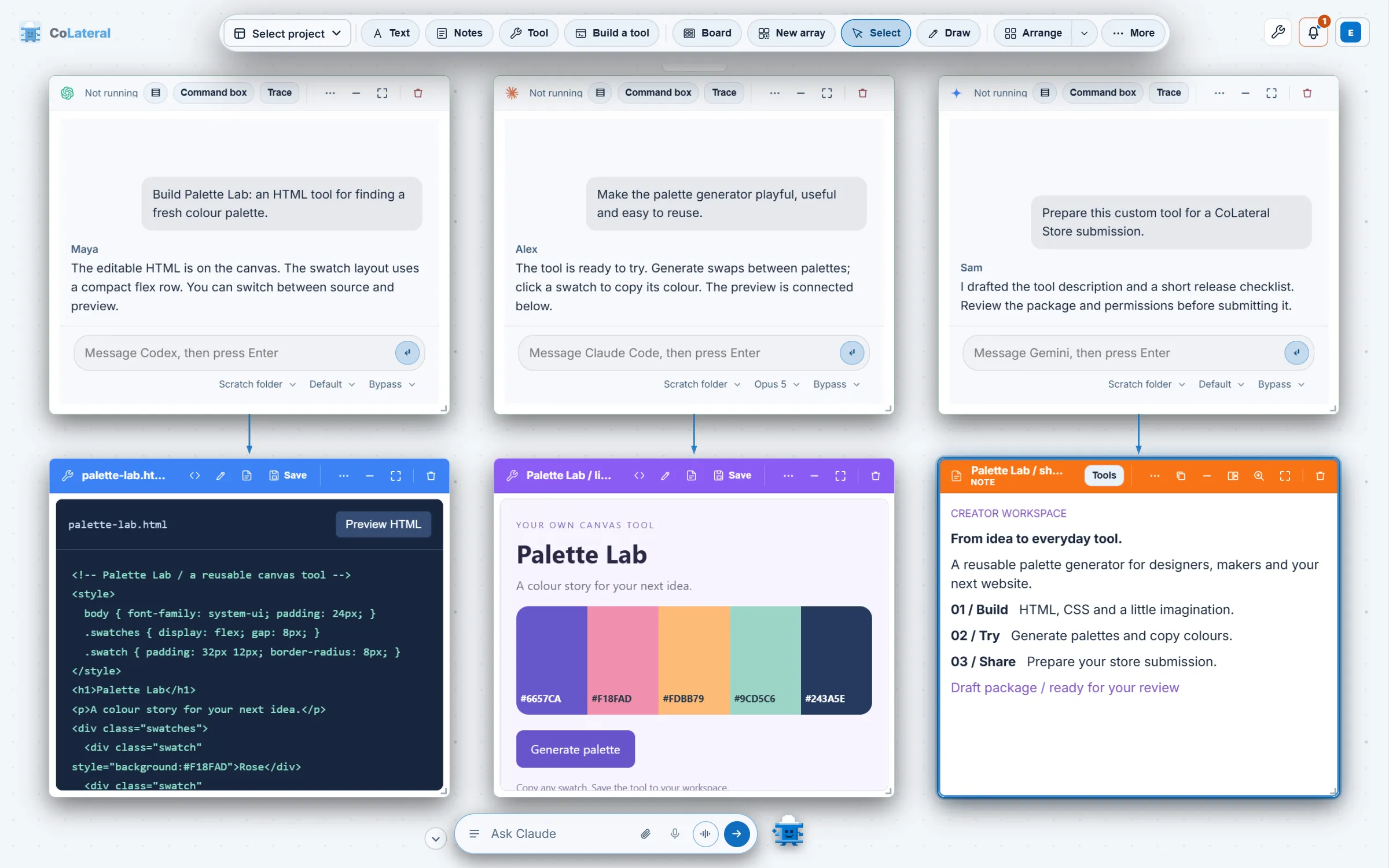
The set kept widening. A Canvas Browser, with scoped control by a connected local agent, arrived on 2026-09-12. Terminal Card agents could run in memory-limited Docker containers when isolation is on from 2026-09-26. Native ChatGPT and Claude cloud agent cards arrived on 2026-10-01, with Gemini and Jules cloud workflows added the same day. Isolated local AI accounts, selectable per terminal, followed on 2026-10-06. Throughout, CoLateral supplies no model credits: you bring your own account. AI agents in CoLateral lists each one and how it got there.
Agents also learned to work on documents: from 2026-08-19 they could write a slideshow, and by 2026-08-26 they could edit spreadsheet, Word and PowerPoint cards.
How did expansion packs and the store come about?
Once the seat was neutral, optional capabilities needed a home. CoLateral Marketing first appeared as the Social Media Pack on 2026-08-25, with a demo recorded on a live canvas, and was renamed in late September. An in-app marketplace and a private creator intake with human review arrived on 2026-09-09, and a payout path for creators of the packs the store sells was added on 2026-08-31. CoLateral Arcade, a games module that is on by default and can be switched off in Settings, was added on 2026-09-26. What is available to add today is on the store and on pricing, and the expansion packs explainer describes the model.
What came next for CoLateral?
The next chapter is being written in the repository now, and the pillar history will keep a record of it. To try the current build, visit the download page.
FAQ
Frequently asked questions
When did CoLateral become an agentic workspace?
The product changed shape between 2026-08-11 and 2026-08-26, with the Command Centre, the filmstrip and a chief of staff. The public headline "The All-in-One Agentic Workspace" appeared in the site title on 2026-09-23 and in the home hero on 2026-09-24.
What is a filmstrip in the CoLateral Project Canvas?
The filmstrip is the row of arrays, which are fixed pages of 1, 2, 4, 6 or 9 equal card slots. The canvas travels between arrays rather than zooming, and the filmstrip is the whole-board overview that replaced the minimap on 2026-08-12.
What does the CoLateral chief of staff do?
The chief of staff is the first entry in the Command Centre. It states what each agent on the board last did, ranks what needs attention and is the same orchestrator as the bottom command bar, running on your own signed-in subscription.
Which AI agents can CoLateral run side by side?
CoLateral runs Claude Code, Codex, Gemini CLI, Copilot CLI and Grok Build agents in Terminal Cards, and has native ChatGPT and Claude cloud agent cards with Gemini and Jules cloud workflows. Each uses your own provider account.
Is CoLateral still only for engineers?
No. CoLateral began as tools the founder built for engineering work, but since 2026-08-11 the base workspace has been discipline-neutral, with optional packs added separately. CoLateral is software and does not provide professional engineering services.