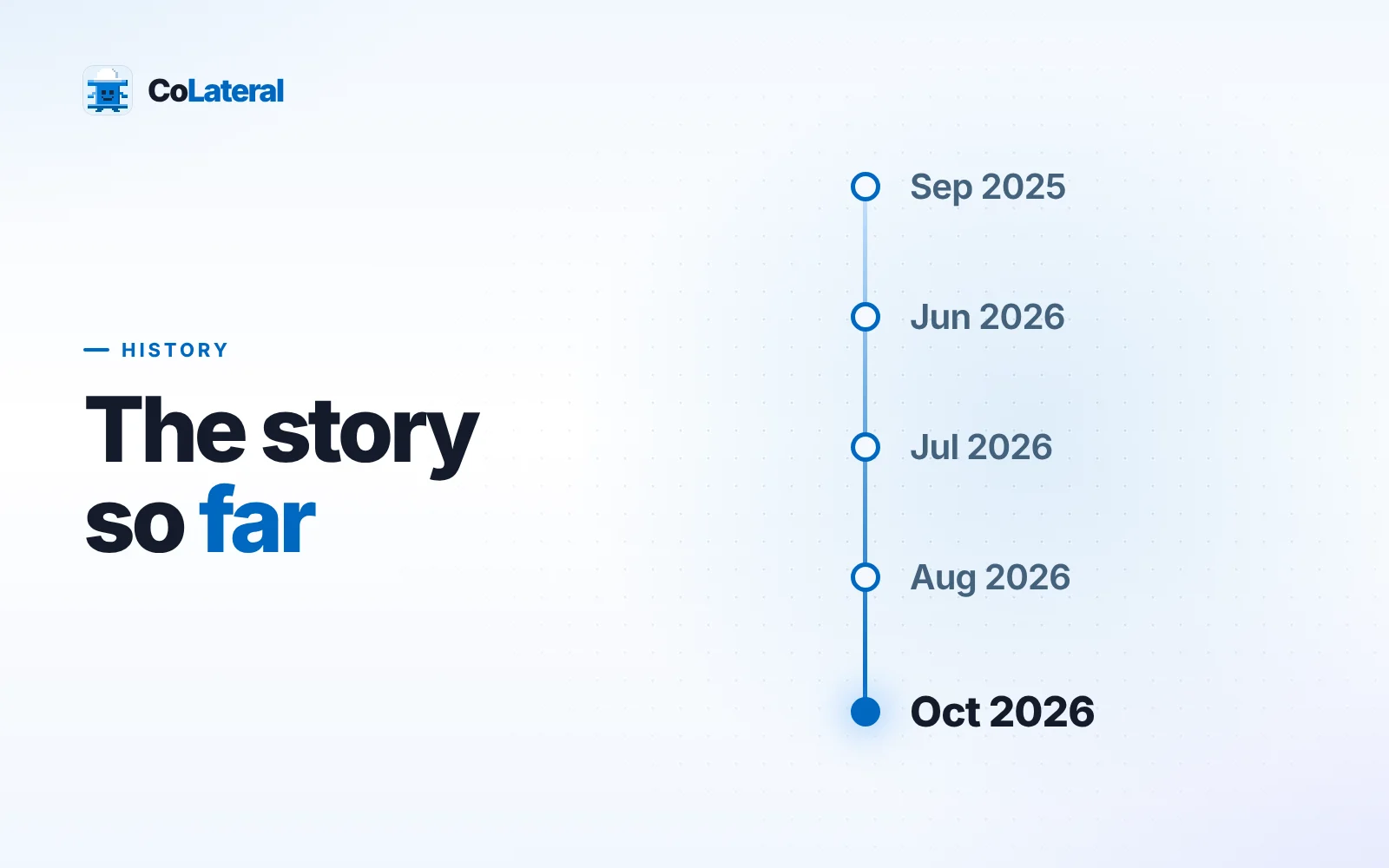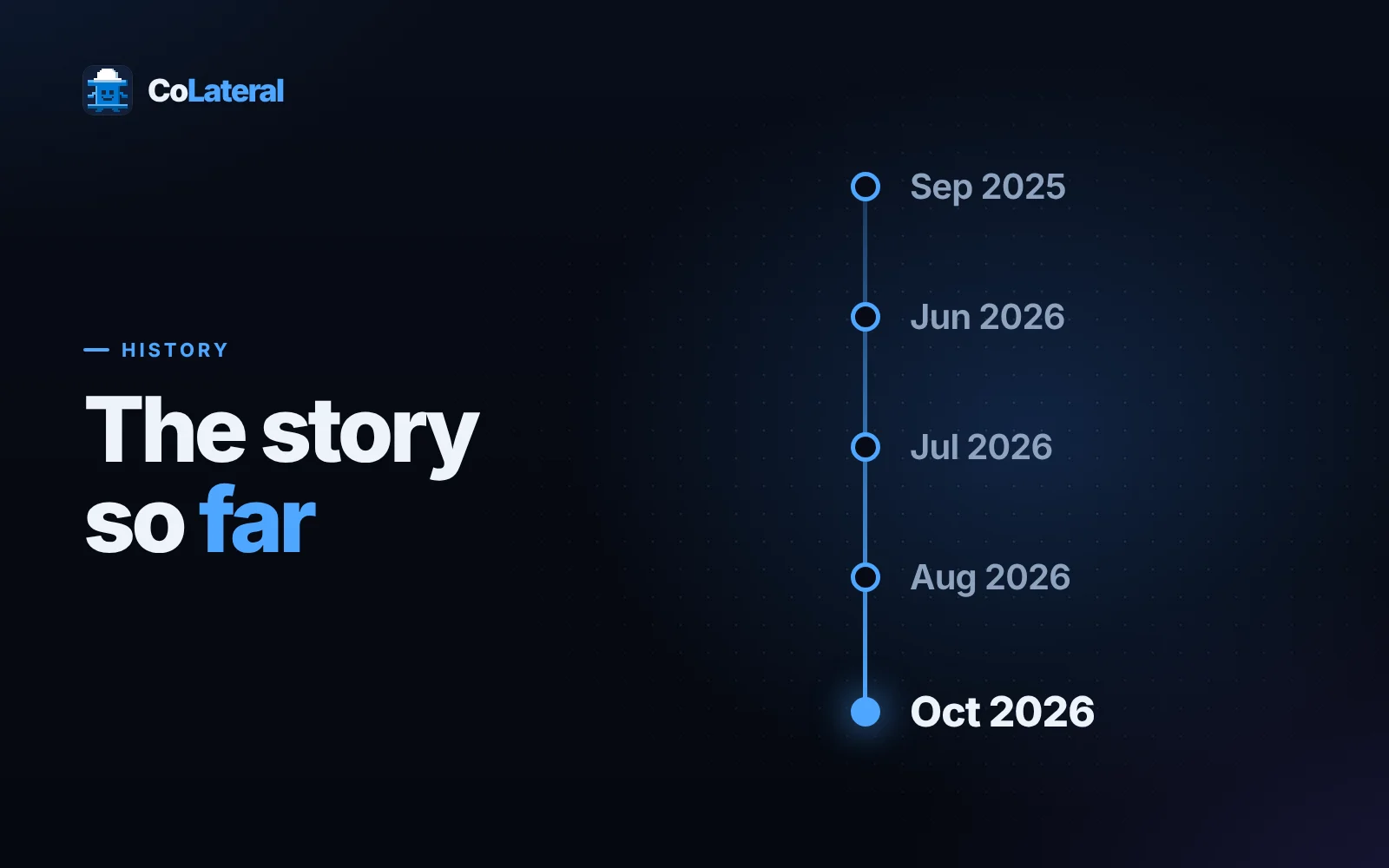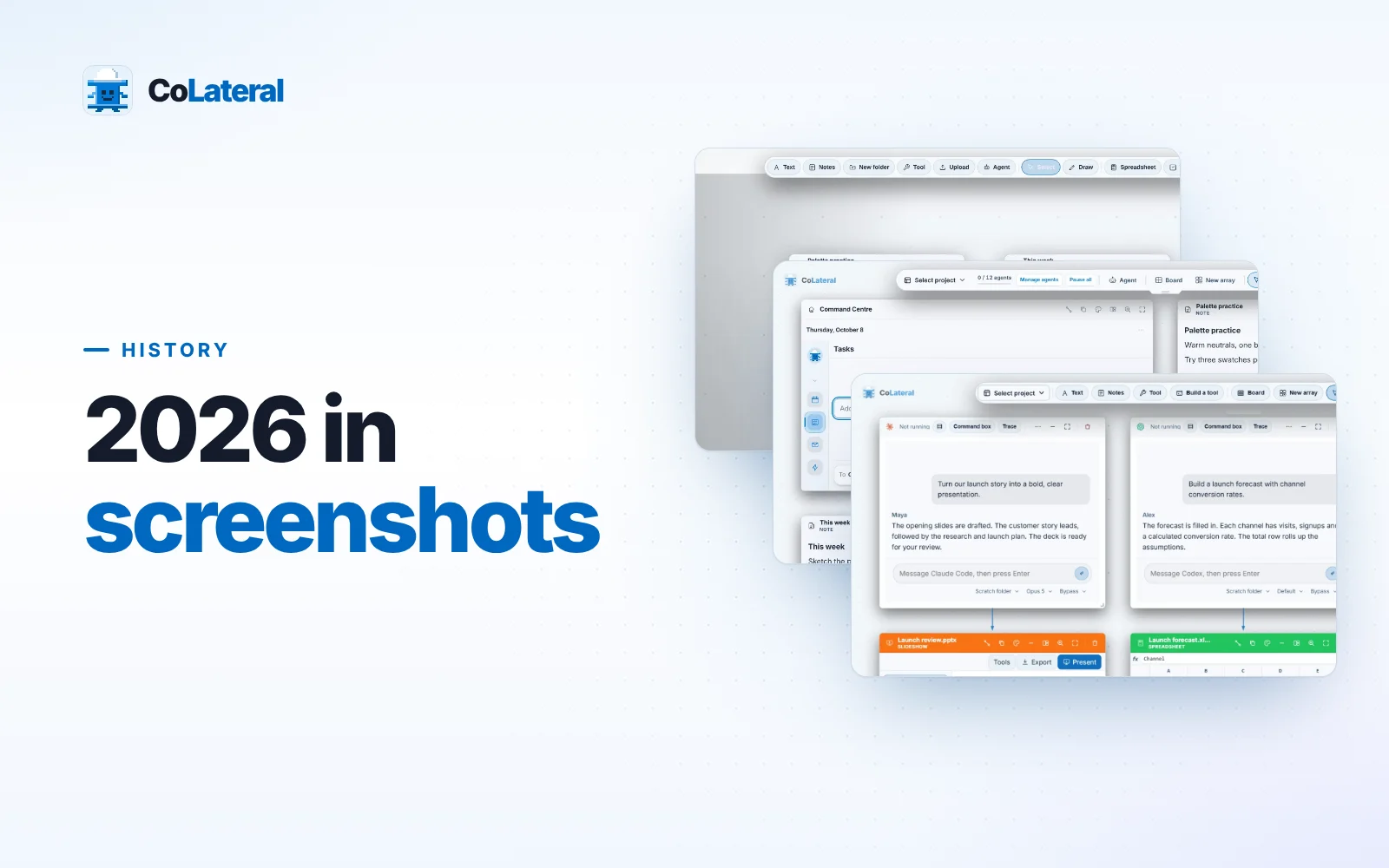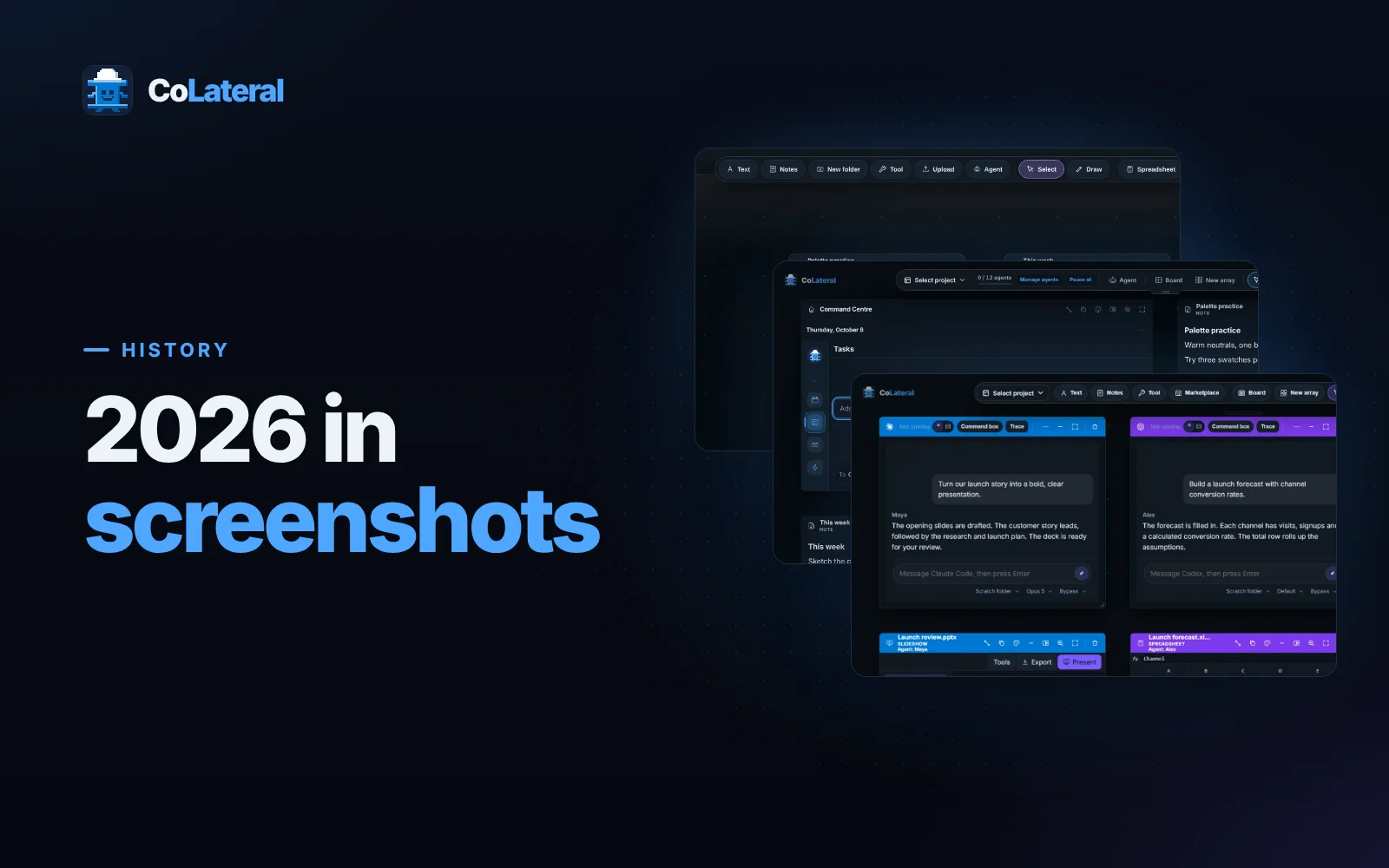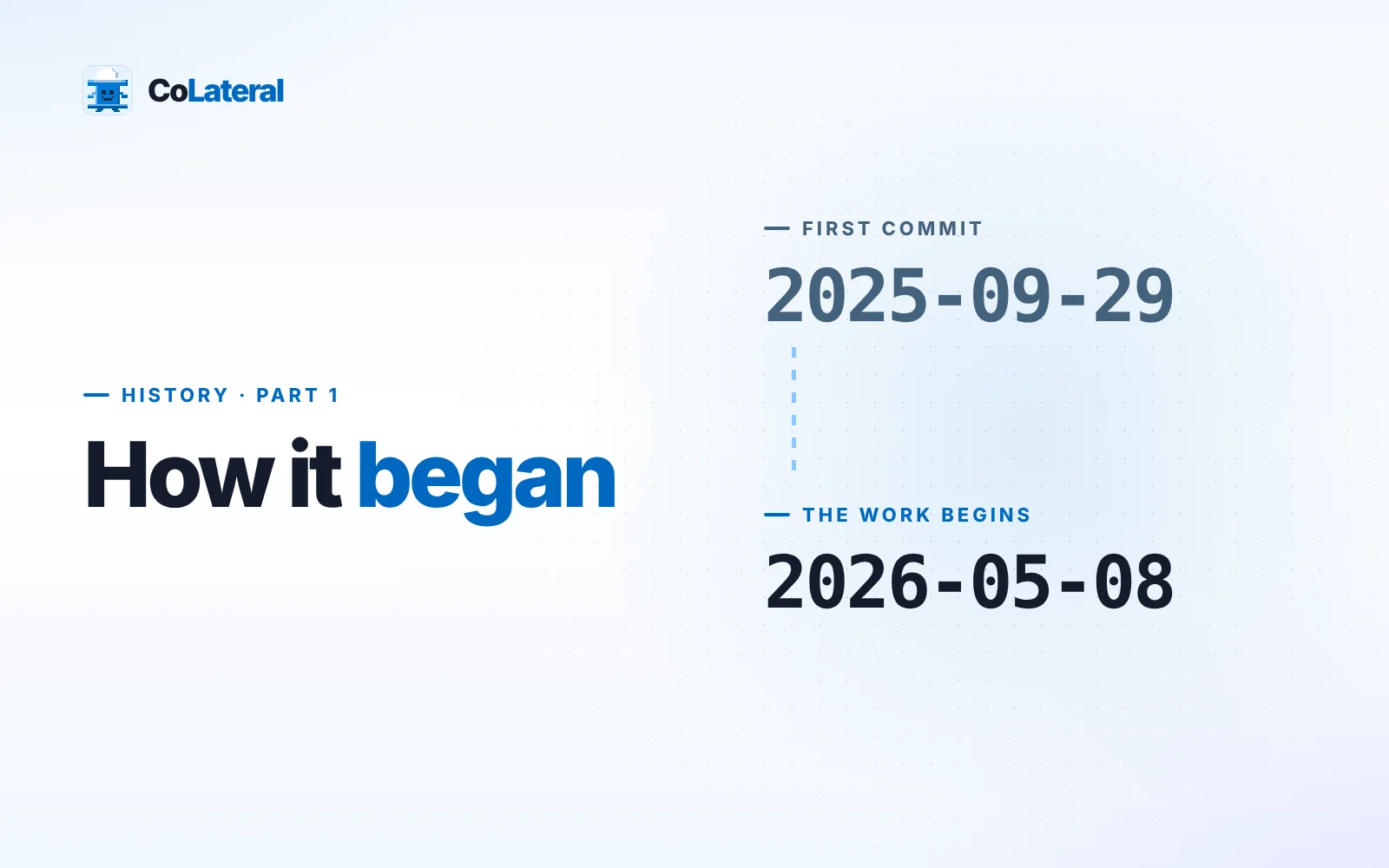
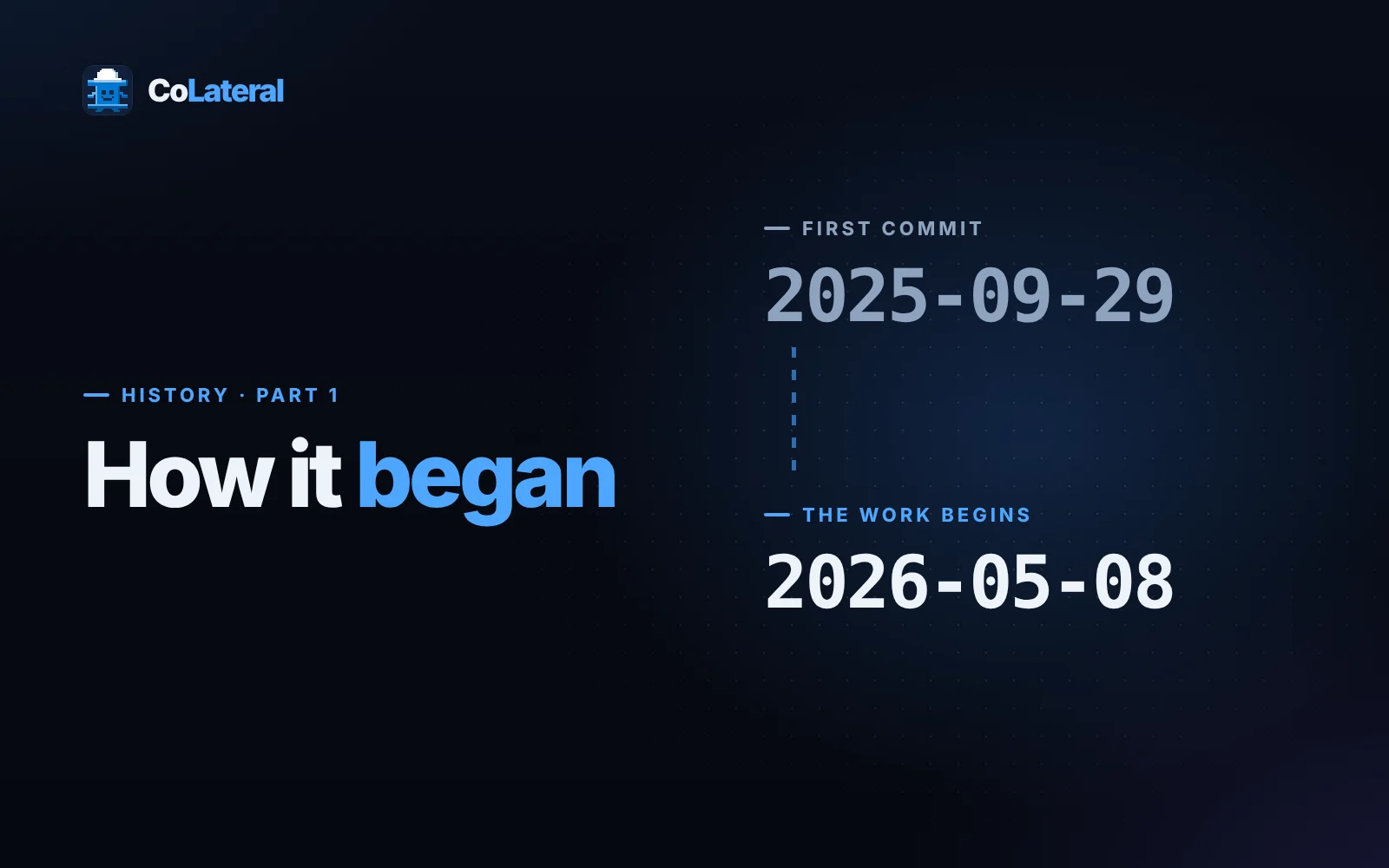
Nothing in that first design looked like today's Project Canvas, which is why it is worth telling accurately. This is part 1 of the history of CoLateral and covers September 2025 to the end of June 2026.
Key takeaways
- The history of CoLateral begins with exactly two commits in 2025, both dated 2025-09-29, and no commits at all between then and 2026-05-08.
- CoLateral recorded 266 commits in May 2026 and 1,330 in June 2026, which is the period in which it became a dashboard of tools with a public website.
- CoLateral's first design was a tool dashboard with a public website; the product took the name "CoLateral AI" on 2026-05-10, and its first AI runtime foundation was committed on 2026-05-27.
- By 2026-06-29 the CoLateral repository held about 70 standalone tool pages, a website and an application in one tree, and that mix is what the desktop pivot set out to separate.
Why does the history of CoLateral start with two commits and a gap?
Because that is what the repository says, and a history that hid it would not be worth reading. The first commit, dated 2025-09-29, is an "Initial commit" that adds a two-line README under the working name Lateral. Later the same day a stock continuous-integration workflow file was added. After that, the commit log has nothing until 2026-05-08.
We do not know from the repository why the work paused, and we are not going to guess. What the record does show is the restart. On 2026-05-08 the first commit of the active period added a small command-line program that generated sets of prompts for AI assistants, and it arrived through a pull request opened by a coding agent. From that date the history is continuous. If you want the whole span at a glance, the full history of CoLateral has the month-by-month commit table.
- commits in 2025, both on 2025-09-29
- 2
- commits in May 2026
- 266
- commits in June 2026
- 1,330
- renamed CoLateral AI
- 2026-05-10
| Date | What happened |
|---|---|
| 2025-09-29 | Initial commit: a two-line README under the working name Lateral, plus a stock workflow file |
| 2026-05-08 | First commit of the active period: a command-line generator of AI prompt sets |
| 2026-05-10 | Tool dashboard becomes the root entry point; project renamed CoLateral AI |
| 2026-05-25 | Terms, Privacy, Security and Trust pages and the Field Notes blog added |
| 2026-05-27 | First AI runtime architecture and developer panel committed |
| 2026-06-29 | Desktop migration plan written; one-time licence replaces monthly tiers |
How did CoLateral begin in May 2026, and what was the first version?
CoLateral began as a dashboard of standalone browser tools. Over its first days the project gained cloud sign-in and project storage (2026-05-09), a tool dashboard page (2026-05-09) that became the root entry point of the site on 2026-05-10, and a rename to "CoLateral AI" the same day. The history of an earlier repository called Lateral was merged in on 2026-05-09, which is why the first week of work contains several changes that look like moves rather than inventions.
The tools themselves were standalone web pages, each a single static page with no build step, built by the founder for his own working day. That "no build step" habit is still in the repository's own description of itself: the application has no production build, and the marketing site is built separately. Static pages are easy to host, which is why a GitHub Pages deployment was enabled on 2026-05-12 and fixed over the following days, and easy for an AI agent to edit, which mattered more than anyone knew at the time.
The dashboard grew a search bar on 2026-05-15, a redesign with a navigation dropdown, and a settings area on 2026-06-05. The work was fast and incremental, with many small pull requests merged each day, and branch names that show Claude and Codex agents doing much of the typing at the founder's direction. That process, a person setting direction and agents doing much of the typing, is the through-line of the whole history, and the founder tells it in building CoLateral in public.
When did the CoLateral website and blog start?
Within weeks of the restart. The About page landed on 2026-05-19 and was reworked in the following days. A pricing page and a careers page followed on 2026-05-24. On 2026-05-25 the project added Terms of Service and a Privacy Policy, a Security and Trust page, a public agents page, a use cases page, and a blog called Field Notes. A self-hosted function replaced a third-party form service for the careers form the same day.
Field Notes was the first blog, and it is a useful marker for this one. It was merged with the blog into a single "Blog" navigation entry on 2026-06-07, and the public Roadmap page was removed the same day. The Field Notes era was short. The blog you are reading is its descendant, rebuilt as a proper section of the site with its own renderer, feeds and structured data.
Pricing is the clearest example of a decision that changed fast. The pricing page was revamped into a four-plan structure on 2026-05-25. On 2026-06-29 a change replaced the four monthly subscription tiers with a single one-time licence. The one-time licence model has stayed. For what it is today, see pricing.
When did AI first appear in CoLateral?
AI appeared in the first commit of the active period, well before the canvas, but in a different shape. That first commit of the active period was an AI prompt generator. On 2026-05-26 a project workspace MVP was committed. On 2026-05-27 came the foundational AI runtime architecture and a developer panel, and the same day a guided AI tool builder that was simplified to a single prompt textbox before the day ended. A versioned prompt registry followed on 2026-06-01.
That AI layer was a foundation, not a live agent. The repository later describes it as a "mock-safe AI runtime with project memory". The idea of a user building their own tool from a prompt is an early form of the "Build a tool" button that sits in the Project Canvas dock today. The idea of an AI that works while you watch did not arrive until the agent and terminal work of July, which the next post in the series covers.
What was the original CoLateral product vision?
A roadmap file was added on 2026-05-15, and it set out a large ambition: a single hub for running every project, from planning through coordination, deliverables and business operations. The file is still in the repository, with a banner added later that marks it as archived and says what changed.
The product is no longer a dashboard-with-a-tool-launcher awaiting a "Project Hub".
The banner goes on to list what replaced it: an infinite Project Canvas that spawns tools, notes and agent cards, a Tauri desktop shell with licence activation, a local agent bridge, a mock-safe AI runtime with project memory, and a marketing site split out on its own.
One small honesty note: that file's banner says it was written in May 2025, but the commit that added it is dated 2026-05-15. We use the commit date, because the commit record is the evidence we can check. The banner's summary of what changed since is, in any case, an accurate one-paragraph version of the rest of this series.
Why did the first CoLateral design stop working?
Because three unrelated concerns shared one tree. By late June 2026 the repository had grown three concerns that did not belong together. A planning document written on 2026-06-29 names them: marketing and website pages at the top level, the application and its dashboard, and a shared layer of code. The document's own description of the problem is blunt.
Three concerns are interleaved in one tree
The same document counts 71 tool folders and observes there is no build step, so the site, the dashboard and every tool were deployed together as one flat static site. That was a fine way to move fast in May. It was a poor foundation for a product people would download, update and pay for once. The work that followed is the subject of the next post.
What came next for CoLateral?
On a single day, 2026-06-29, the project wrote its desktop migration plan, extracted shared code into packages, added a minimal Tauri v2 shell and committed the first Project Canvas. From tool dashboard to Project Canvas tells that story. If you want to see how these early screens looked, the visual history has captures era by era, and the download page has the app as it is now. To learn who is behind it, see about CoLateral.
FAQ
Frequently asked questions
When was the first CoLateral commit?
The first commit in the CoLateral repository is dated 2025-09-29 and adds a two-line README under the working name Lateral. A stock workflow file was added the same day. There are no further commits until 2026-05-08.
What was the first thing built in CoLateral?
The first commit of the active period, on 2026-05-08, added a small command-line generator for sets of AI prompts. A dashboard of standalone tools followed within a day, with cloud sign-in and project storage on 2026-05-09.
When did CoLateral get its name?
The dashboard was renamed "CoLateral AI" on 2026-05-10, a day after the history of an earlier repository called Lateral was merged in. The brand has since been simplified to CoLateral, with colateralai.com as the website.
Who started CoLateral?
CoLateral was started and is directed by its founder, Nic Vandewetering, and the build is documented in public. The about page says who is behind it, and building CoLateral in public explains how the work is done.
Why is CoLateral a one-time licence instead of a subscription?
The four monthly subscription tiers were replaced by a single one-time licence on 2026-06-29, and that model has stayed. The reasoning is in why CoLateral is a one-time licence, and current terms are on the pricing page.
Did CoLateral always have a blog?
A blog called Field Notes was added on 2026-05-25 and merged into a single Blog entry on 2026-06-07. The current CoLateral blog launched on 2026-10-08 as a separate section of the site, with this history as one of its first posts.
Was CoLateral always built by AI agents?
Much of the early work arrived through pull requests opened by AI coding agents that the founder directed, and the repository is arranged so that agents can work in it. The direction, the decisions and the product judgement are Nic Vandewetering's, and the build is done in public.