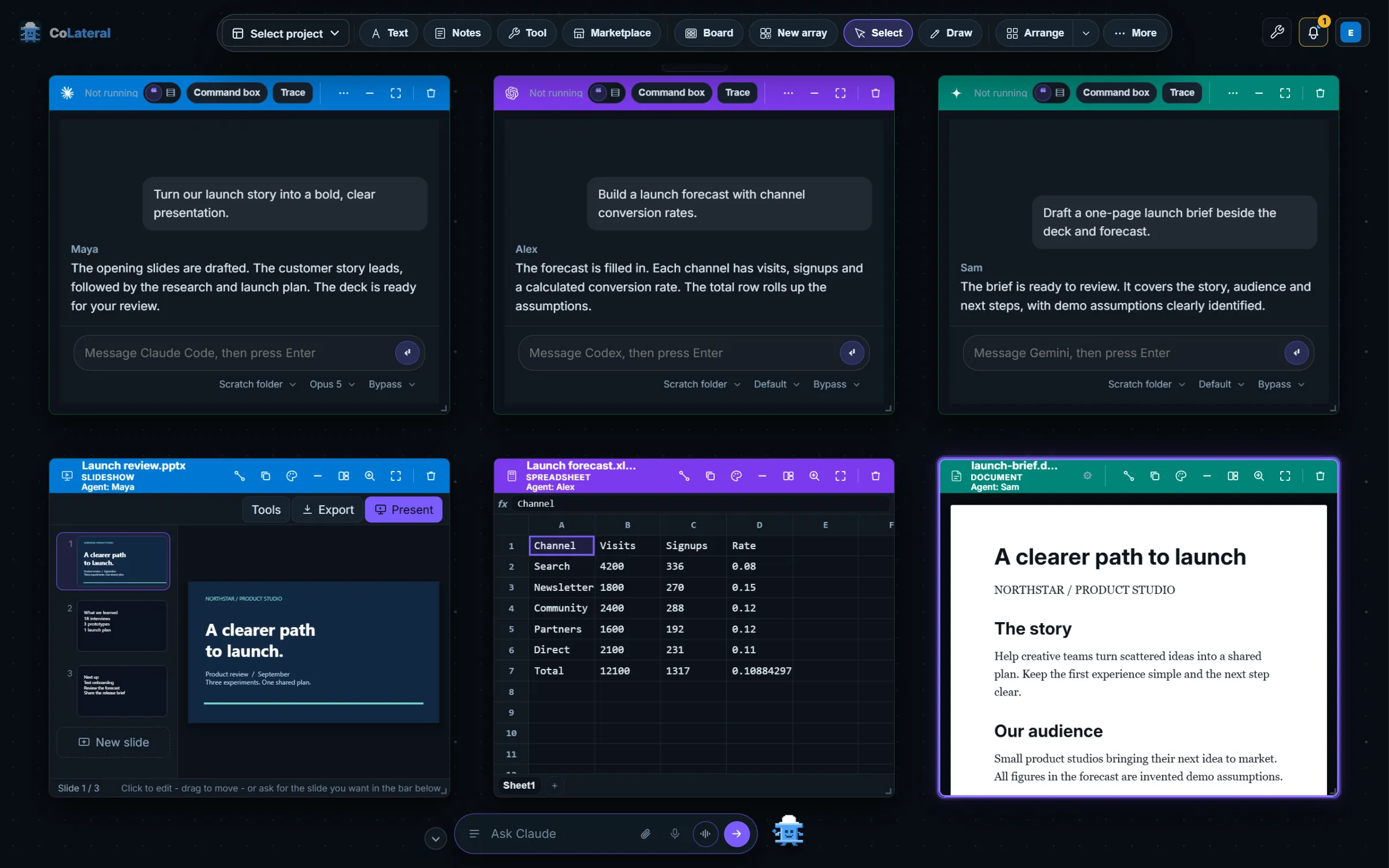
The model chip on each agent card and the model picker in Settings, which since September 2026 read their names from the CLI you have installed instead of from a list we maintain. That is why a model such as Sonnet 5.5 can appear in the picker through a five-file change and why a model your account cannot use is not offered. This post traces how the chip and the pickers developed between August and September 2026, what each agent's list shows today, and what to do when a new model ships.
Key takeaways
- CoLateral's agent cards carry a model chip beside the folder and permission chips. It arrived on 22 August 2026 so you can see which model a card runs and switch it without typing a command.
- CoLateral's Claude Code picker lists Opus 5.5, Sonnet 5.5, Haiku 4.5 and Fable 5.1 as written-down names, and refreshes them from the installed Claude Code's own model menu where it can read it.
- Since 22 September 2026 CoLateral also lists Codex and Gemini models from the installed CLIs, so a model the CLI learns about can appear without a CoLateral release.
- CoLateral never claims a switch that did not happen. On CLIs that cannot switch models mid-session the chip says the change applies at relaunch, and it goes amber when the pin and the running session disagree.
Where do you choose a model in CoLateral?
There are three places, and each answers a different question. The agent card's model chip decides what a single Terminal Card runs. The orchestrator model setting decides what the bottom bar's chosen CLI runs for typed requests. Voice mode has its own model choice, which is a realtime model or a ChatGPT subscription through Codex. CoLateral itself ships no model. Every list below is a list of models that your own agent and account can run.
How did the model chip arrive?
Before 22 August 2026, which model a Terminal Card ran was pinned in a settings panel and only reached the CLI at launch. Someone watching a card work could not see what it was on, and changing it mid-session meant typing the CLI's own model command and answering its menu, which surfaced in the chat as a blocked question. The chip moved the choice onto the prompt row.
Switching is honest about what the CLI allows. On a running Claude Code session, CoLateral types the CLI's own model command with the name attached, which Claude Code takes without a menu. Codex and Gemini open an interactive picker for that command and the other CLIs have no in-session command, so CoLateral types nothing, the chip says the change applies at relaunch, and it turns amber if the pin and the live session disagree rather than claiming a switch that did not happen.
That honesty was tightened on 14 September 2026. The chip had reported what it asked for, not what the session was on, so a switch the CLI did not take left the chip naming a model that was not running. Claude Code repaints its model name beneath the composer every frame, so CoLateral now reads the running model back from the screen and reconciles the chip against it. A switch that cannot be typed because the agent is waiting on a question is queued and typed when the session is free, instead of being dropped.
How did each release change the picker?
The model chip
The model moved onto the agent card's prompt row, with a live switch for Claude Code and a relaunch note for CLIs that cannot take one.
The Claude menu Claude Code actually has
The picker offered half-names for Opus, Sonnet and Haiku, lacked Fable and used a browser prompt for Other. It became the full-name list Claude Code's own menu shows, with no Other entry.
Ask each agent what models it has
A catalogue now runs a provider's own listing, or for DeepSeek reads the endpoint's list with your key, when you open the picker. It never runs a command that needs a sign-in, and a failure is an empty list rather than an error.
An orchestrator model setting
Settings gained a picker for the model of the CLI that runs the bottom bar, so a session on Opus does not keep answering after you pick Sonnet.
Names carry the version
A picker still saying Fable 5 a release after Fable 5.1 shipped prompted a change: the names now carry the version, and a test reads the menu out of the installed Claude Code and fails when CoLateral's names fall behind. A Claude card now always names a model and starts on Opus, which is what Claude Code's own default resolves to.
Grok 4.6
Grok 4.6 was added to the Grok Build picker. It was named because Grok's own listing named it as what every new session starts on.
Pickers read the installed CLIs
The orchestrator picker said Opus 5 while Claude Code's opus alias already ran Opus 5.5, so the bridge began reading the names from the installed Claude Code. The same day Codex and Gemini model lists came from their installed CLIs, and the card menu was deduplicated so one model shows once.
Sonnet 5.5 shows
The picker began reading Claude Code's native model registry, so Sonnet 5.5 appeared. The change touched five files, two of them tests.
What does each agent's model list show today?
| Agent | What the picker shows | Why |
|---|---|---|
| Claude Code | Opus 5.5, Sonnet 5.5, Haiku 4.5, Fable 5.1 | Claude Code's own model menu is fixed and every signed-in account is offered it |
| OpenAI Codex | Agent default, Other, plus the rows Codex lists in its own models cache | Which models Codex offers is decided by the account and the installed version |
| GitHub Copilot CLI | CLI default, Auto, Other | The list is decided by the seat and the organisation's policy |
| Gemini CLI | CLI default, 2.5 Pro, 2.5 Flash, Other | The two named entries are plain aliases offered on the free tier; newer preview models are reachable through Other |
| Grok Build | CLI default, Grok 4.6, Grok 4.5, Other | Grok 4.6 is what a new session starts on; Grok 4.5 stays listed as the previous default |
| Kiro, Cursor, OpenCode | CLI default, Other | Their lists depend on the account or what you signed in to, and are not printed without a sign-in |
| DeepSeek | Agent default, V4 Pro, V4 Flash, Other | Short aliases that the bridge expands in the environment |
Why does the picker show names the CLI prints?
Because a written-down list goes stale without anything breaking. Claude Code's picker is four aliases that keep working when the model behind one is replaced, so a CoLateral label can fall behind its model while the card launches fine. The comment in the code says it directly: Settings said Opus 5 while the opus alias already launched Opus 5.5. So the card stores the alias, which survives a release, and the visible name is read from the installed CLI.
For most other agents the opposite problem applies. A hardcoded model that an account is not entitled to is a card that will not start, and which models an account has is decided by its plan. So CoLateral asks the machine that knows. The same rule explains why Kiro and Cursor are not read automatically: their listing commands open a sign-in, and a sign-in triggered by opening a dropdown is not something a picker should do.
What should you do when a new model ships?
- Update the agent's CLI first. CoLateral reads the model names from the CLI you have installed, not from the provider's website.
- Open the model chip on the agent card, or the orchestrator model picker in Settings. If the CLI lists the model, it should appear. If it is not listed, use Other and type the name your plan allows.
- Check what is actually running. The chip reads the running model back from Claude Code. On other agents a change applies at relaunch, and an amber chip means the pin and the session disagree.
- Check the provider's plan limits. The subscription usage bar shows windows where a provider records them, and a bigger model can draw a window down faster.
The same pattern covers the other agents on the canvas; every AI agent CoLateral runs lists them, and running Claude Code and Codex side by side shows two cards with different model chips. The orchestrator's own model setting is covered in the orchestrator and Command Centre. Models run on your own accounts, so check the setup answers for installing a CLI, the pricing page for the CoLateral licence, and the download page for the app.
FAQ
Frequently asked questions
Which Claude models does CoLateral list?
The Claude Code picker lists Opus 5.5, Sonnet 5.5, Haiku 4.5 and Fable 5.1 as written-down names, and refreshes them from the installed Claude Code's own model menu where it can read it. A model pinned outside the list is kept as its own entry.
Does CoLateral include access to Claude, GPT or Gemini models?
No. CoLateral supplies no model credits. The model chip and picker choose among models that your own CLI and account can run, and provider subscriptions and API charges are separate from the CoLateral licence.
Why is a new model missing from the CoLateral picker?
Update the CLI first, because CoLateral reads names from the installed CLI. If the CLI does not list the model, or your plan does not offer it, use the Other entry and type the name your account allows. Kiro and Cursor lists are not read automatically because their listing commands open a sign-in.
Can I switch models while an agent is running?
On Claude Code, yes: CoLateral types the CLI's own model command for you. On the other agents the change applies at relaunch, and the chip says so and turns amber if the pin and the running session disagree.
What model does a new Claude card start on?
Opus. A Claude card always names a model, and it starts on Opus because that is what Claude Code's own default resolves to. You can pin another one from the chip.